Article
Plants Commonly Mistaken for Japanese Knotweed (With Photos)
Photos and fastest tells for the plants that look like Japanese knotweed in Ireland: bindweed, Russian vine, Himalayan balsam, dock, bamboo, lilac and more.
Most plants that look like Japanese knotweed turn out to be something else, and usually something far less serious. The official Irish guide to the plant and the Royal Horticultural Society both keep lists of species Japanese knotweed is mistaken for, because mistaken reports are common enough that both organisations address them directly. This page walks through those plants one by one: what each one looks like, why it triggers the alarm, and the single fastest feature that separates it from knotweed. Knotweed is genuinely serious, and our complete guide to Japanese knotweed in Ireland covers the law, property and treatment if you do have it. But start here: in most cases a closer look rules knotweed out.
Key Takeaways - Knotweed is ruled in by three features together: hollow, bamboo-like canes with red-purple speckling; spade-shaped leaves with flat bases in a zig-zag along the stem; and clusters of small creamy-white flowers in late summer, followed by dead brown canes all winter. - A plant that twines or climbs around a support (bindweed, Russian vine) is not knotweed: knotweed never climbs and never needs support. - Trumpet flowers, pink bonnet flowers or fragrant purple clusters all belong to other plants, as does any plant that is still green and leafy in midwinter (bamboo). - Two of the lookalikes, Himalayan balsam and Himalayan knotweed, are themselves listed as invasive species in Ireland under SI 477/2011.
Quick Comparison Table
The short version of this page: find your plant, apply the tell.
| Plant | Why it is mistaken for knotweed | Fastest tell | | --- | --- | | Hedge bindweed | Heart-shaped leaves and vigorous growth over fences | It twines around supports; knotweed never does | | Russian vine | Same plant family, similar sprays of tiny pale flowers | A woody climber reaching 8 m or more; knotweed stands free at 2-3 m | | Himalayan balsam | Tall stems that are hollow and reddish | Finely serrated leaf edges and pink bonnet flowers | | Broad-leaved dock | Big leaves and rusty seed heads into winter | A flat rosette of oval leaves; no bamboo-like cane at any stage | | Bamboo | Upright canes with visible nodes, like knotweed's stems | Evergreen: still green and leafy in winter, when knotweed is dead brown canes | | Common lilac | Heart-shaped leaves on a vigorous plant | Hard woody stems that persist for years; fragrant purple flowers in early summer | | Himalayan knotweed | A related knotweed with a similar upright habit | Long, lance-like leaves; regulated in Ireland in its own right |
Japanese Knotweed at a Glance
Japanese knotweed is a herbaceous perennial: everything above ground dies each winter and regrows from an underground rhizome in spring. According to the Royal Horticultural Society and invasives.ie, the year runs from rounded pink buds and reddish-purple "asparagus tip" shoots in spring, through hollow, bamboo-like summer stems speckled red-purple with conspicuous nodes, typically about 2 m and sometimes 3 m. The leaves are spade-shaped with flat bases, and the GB Non-Native Species Secretariat is explicit that they are truncate rather than cordate: flat-bottomed, not heart-shaped. They sit in a zig-zag pattern along the stem. Clusters of small creamy-white flowers follow in late summer and early autumn, and in winter the dead, brown, cane-like stems stand or lie on the ground.
Every comparison below turns on those features, especially the flat leaf base. For the full season-by-season walkthrough, including the orange-centred rhizome, see our Japanese knotweed identification guide.
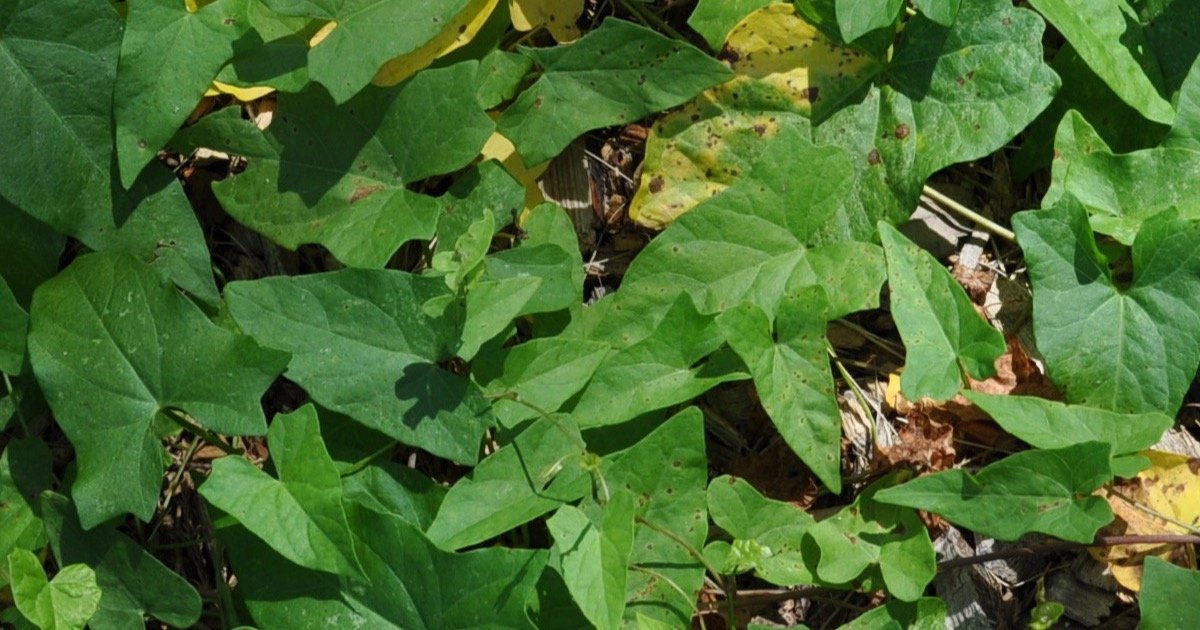
Hedge Bindweed (Calystegia sepium)
If the plant is winding itself around your fence, hedge or another plant, it is bindweed. Japanese knotweed never twines and never needs support: its canes stand on their own or arch over at the top. That habit alone settles the question.
The RHS guide to bindweed describes a twining or trailing climber whose stems reach about 3 m, wrapping around whatever they encounter, with perennial roots that can go 4 m deep. Its leaves are genuinely heart-shaped, up to about 12 cm, and the decisive difference is the base: knotweed's leaves are spade-shaped and flat-bottomed rather than cordate. Bindweed's flowers are funnel-shaped trumpets, white or pale pink and around 5 cm across, open from June to September, while knotweed's are small creamy-white clusters in late summer and autumn.
Both plants die back in autumn, so winter growth alone will not separate them, though thin stems left coiled around a fence in winter are a bindweed signature. The smaller field bindweed (Convolvulus arvensis) behaves the same way on a much smaller scale: stems under 1 m, flowers about 2 cm.
Russian Vine (Fallopia baldschuanica)
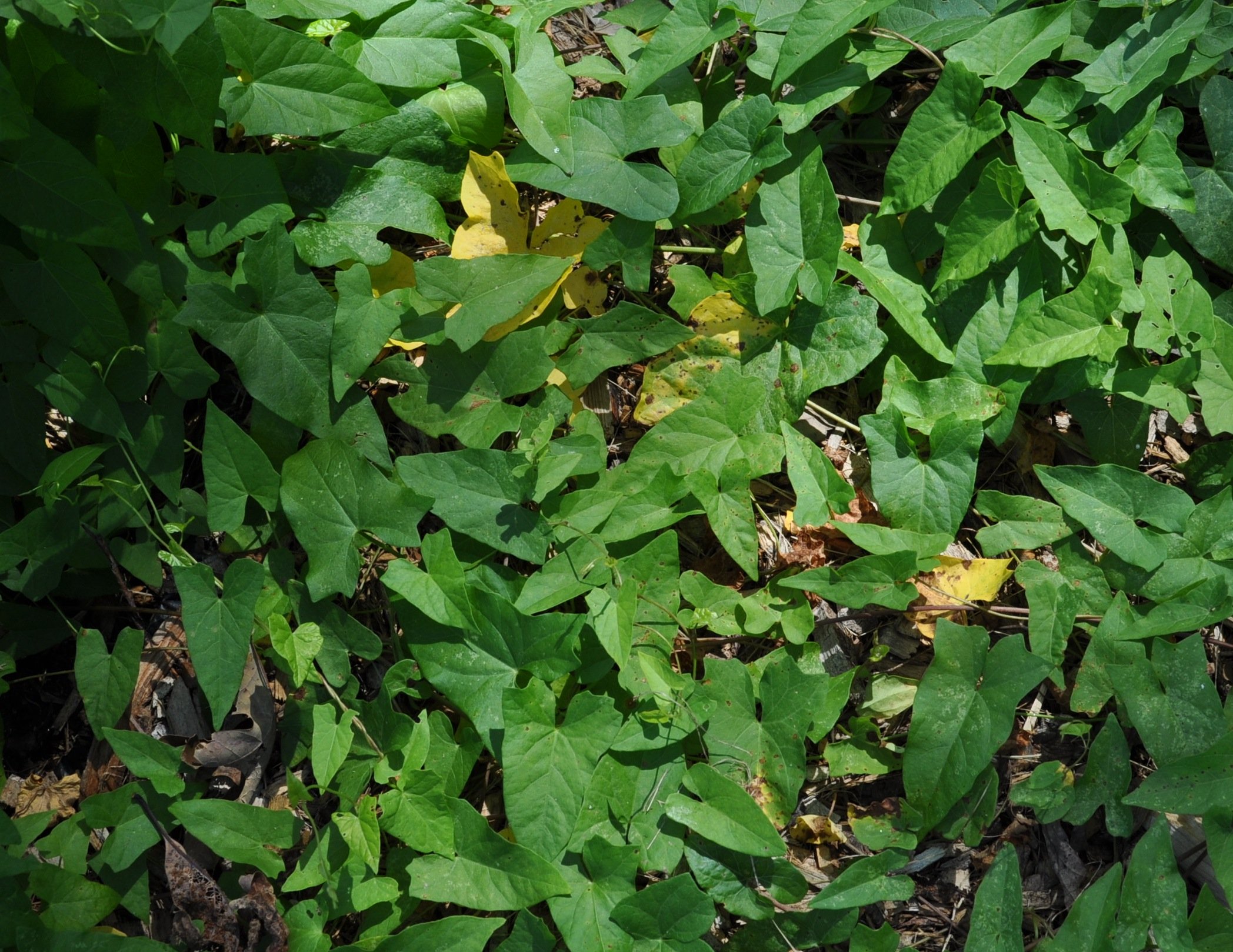
Russian vine, also known as mile-a-minute, produces sprays of tiny pale flowers that genuinely resemble knotweed's, because the two belong to the same family. The difference is mechanical: Russian vine is a climber that covers 8 m or more by twining, while knotweed stands free at 2 to 3 m and never climbs anything.
The RHS plant profile describes a vigorous, woody, twining deciduous climber scaling 8-12 m high and 4-8 m wide, needing strong supports and regular pruning to stay in check, with heart-shaped dark green leaves, panicles of tiny pink-white flowers in summer and small pink fruits afterwards. The RHS includes it among the garden plants confused with knotweed, and the shared family explains why: the flower sprays look similar at a glance, the habit does not. If the suspected knotweed is draped over a shed roof or smothering a hedge, it is not knotweed.
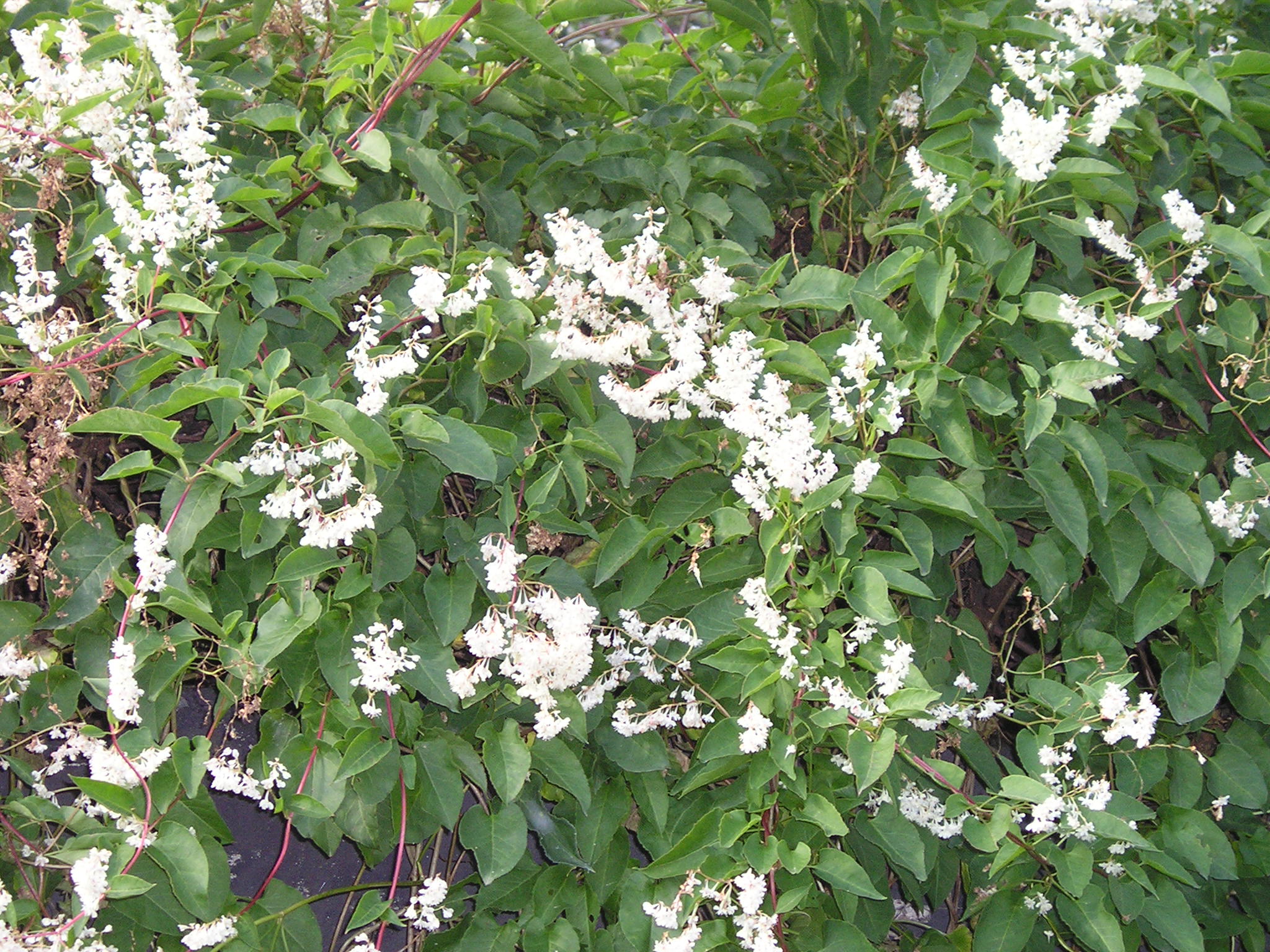
Photographed in October: the twining habit is the tell at any time of year, flowers or none.
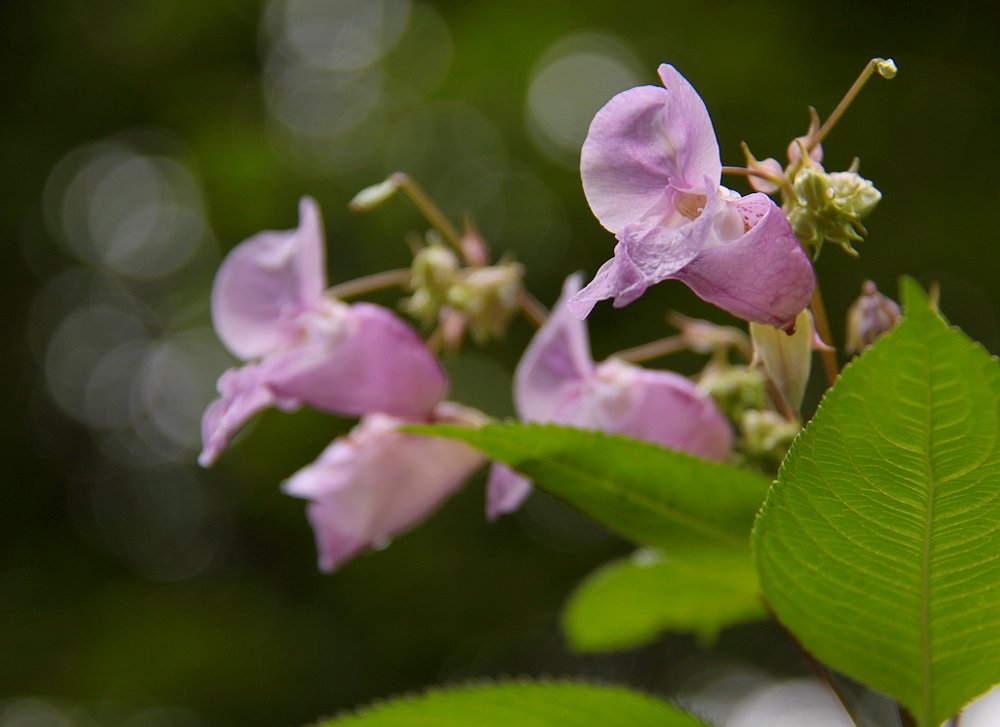
Himalayan Balsam (Impatiens glandulifera)
Check the leaf edge and the flower, because the stems will not help you: Himalayan balsam has sturdy hollow stems, often with reddish tints, so on stems alone the two plants genuinely overlap. The official Irish knotweed guide contrasts them directly: balsam's leaf edges are "toothed", like a knife, against knotweed's smooth-edged spade leaves, and its stems are very fragile where knotweed's canes are sturdy. The flowers end any doubt: scented pink to purple, bonnet-shaped blooms, the "policeman's helmet", from June to November, against knotweed's small creamy-white clusters.
The RHS balsam page completes the picture: a fast-growing upright annual reaching about 2 m, with lance-shaped, finely serrated leaves; explosive seed pods that fling seed up to 7 m; and shallow roots rarely growing deeper than 15 cm, nothing like knotweed's deep, woody rhizome. Being an annual, the whole plant dies in autumn or early winter, leaving straw-coloured stems behind.
One caution keeps this entry from being pure relief: Himalayan balsam is itself listed on Part 1 of the Third Schedule of SI 477/2011 in Ireland, and in the UK under Schedule 9 of the Wildlife and Countryside Act 1981 (UK). Our guide to Japanese knotweed in Ireland covers what that listing means.
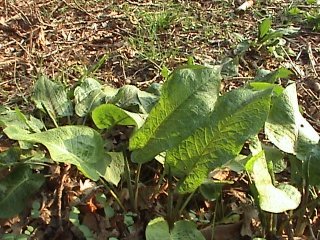
Broad-Leaved Dock (Rumex obtusifolius)
Dock never builds a cane. Knotweed's identity is its hollow, bamboo-like stems; dock grows as a flat rosette of leaves with flower stems rising from the middle, and it never forms a stand of canes at any stage.
The RHS docks page describes a robust, long-lived perennial: low rosettes of new leaves appear in spring, followed by upright flower stems through summer reaching about 1.2 m, carrying small pale green and red flowers, with reddish-brown fruits that can persist into winter. The leaves drive the confusion because they are large, up to about 30 cm long and 15 cm wide, but they are oval with slightly wavy edges, not spade-shaped, and they rise from the rosette rather than zig-zagging along a stem. Underground, dock has a branching taproot that can reach 1.2 m and regrows from fragments, but it bears no resemblance to knotweed's orange-centred rhizome. A UK footnote: docks on agricultural land fall under the Weeds Act 1959 (UK); there is no equivalent Irish listing for dock.
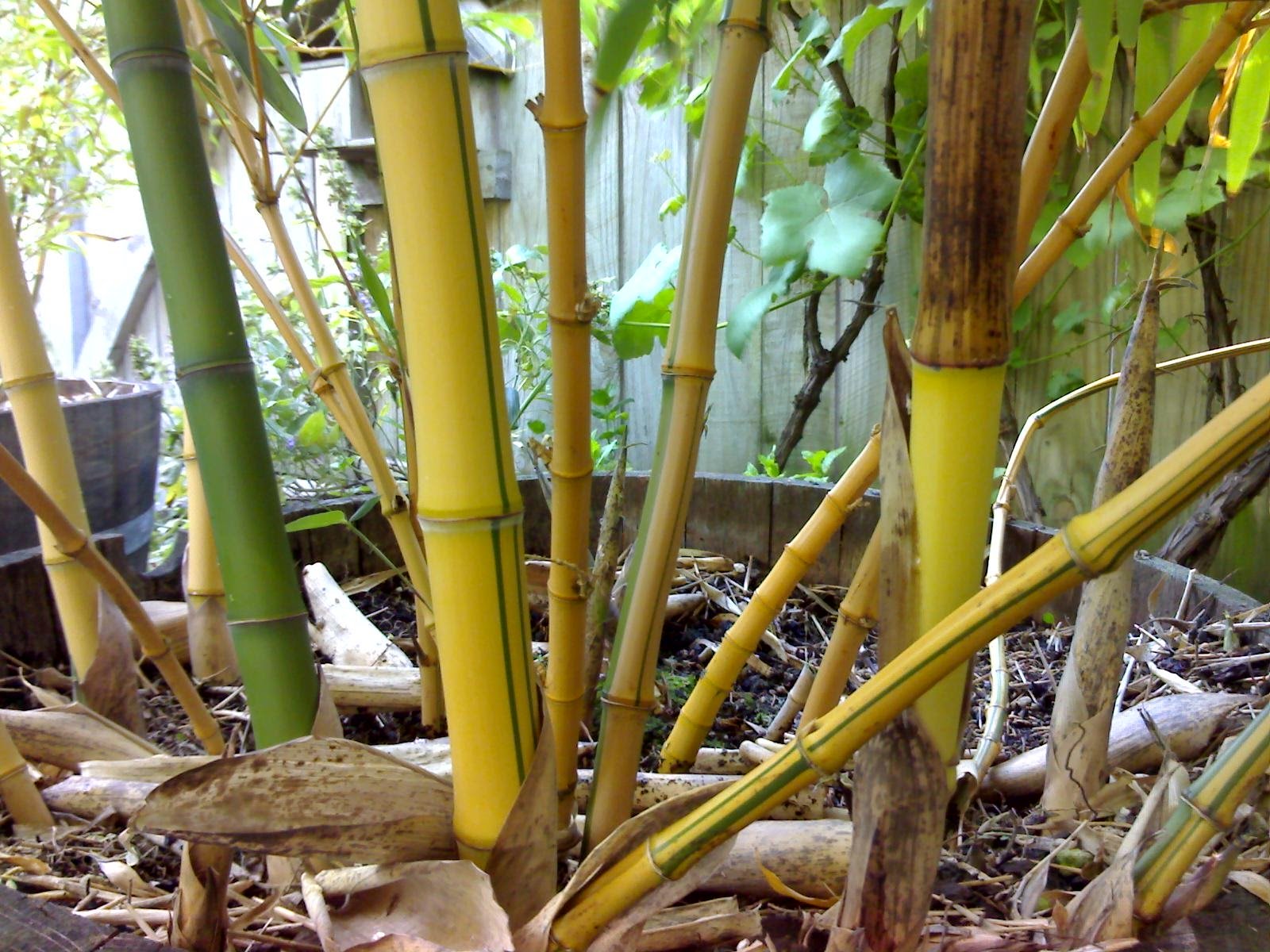
Bamboo
If the patch is still green and leafy in the middle of winter, it is bamboo: Japanese knotweed dies back completely each year to dry, brown, leafless canes. Bamboo is one of the two plants the official Irish guide names as mistaken for knotweed, and the structural overlap is real.
The RHS bamboo guidance describes upright or arching canes, culms, with growing points, or nodes, along their length, which is precisely what echoes knotweed's stems. The separator, invasives.ie notes, is "the shape of the leaf and zig-zag leaf arrangement": bamboo leaves are typically lance-shaped with a pointed tip, while knotweed's are broad spades with flat bases set in a zig-zag down the stem. Behaviour can overlap too: running bamboos spread by rhizomes in roughly the top 30 cm of soil, can advance more than 1 m a year, and regrow from any rhizome section with a node. Heights overlap as well, from dwarf Sasa species under 2 m to Phyllostachys above 3 m, but bamboo holds its leaves year-round and puts on no display of creamy-white flowers in late summer.
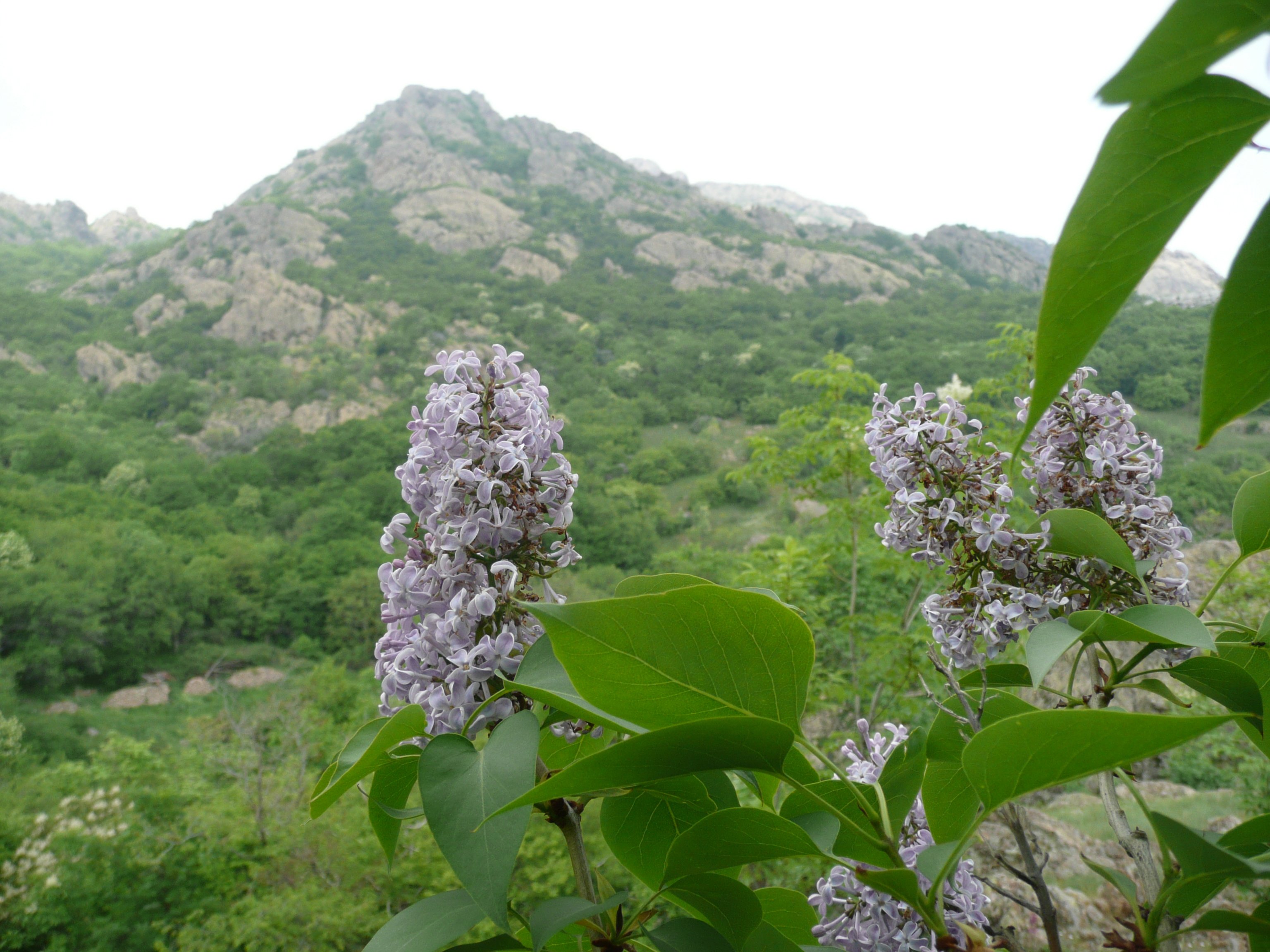
Common Lilac (Syringa vulgaris)
Lilac is a woody shrub, and wood settles it. Its stems are hard and persist for years, thickening into what the RHS lilac profile calls a bushy thicket of around 7 m by 7 m; knotweed's canes are herbaceous, hollow and new every year.
The leaf is what raises the alarm. Lilac has green heart-shaped leaves, and a heart-shaped base is precisely what the GB Non-Native Species Secretariat uses to rule knotweed out, since knotweed leaves are spade-shaped with flat, truncate bases. The flowers could not be more different, and they arrive months apart: lilac's light blue-purple blooms are very sweet-smelling in early summer and carried in conical panicles, while knotweed's small creamy-white clusters appear in late summer and autumn. Lilac belongs to the Oleaceae family and is not native to Britain or Ireland.
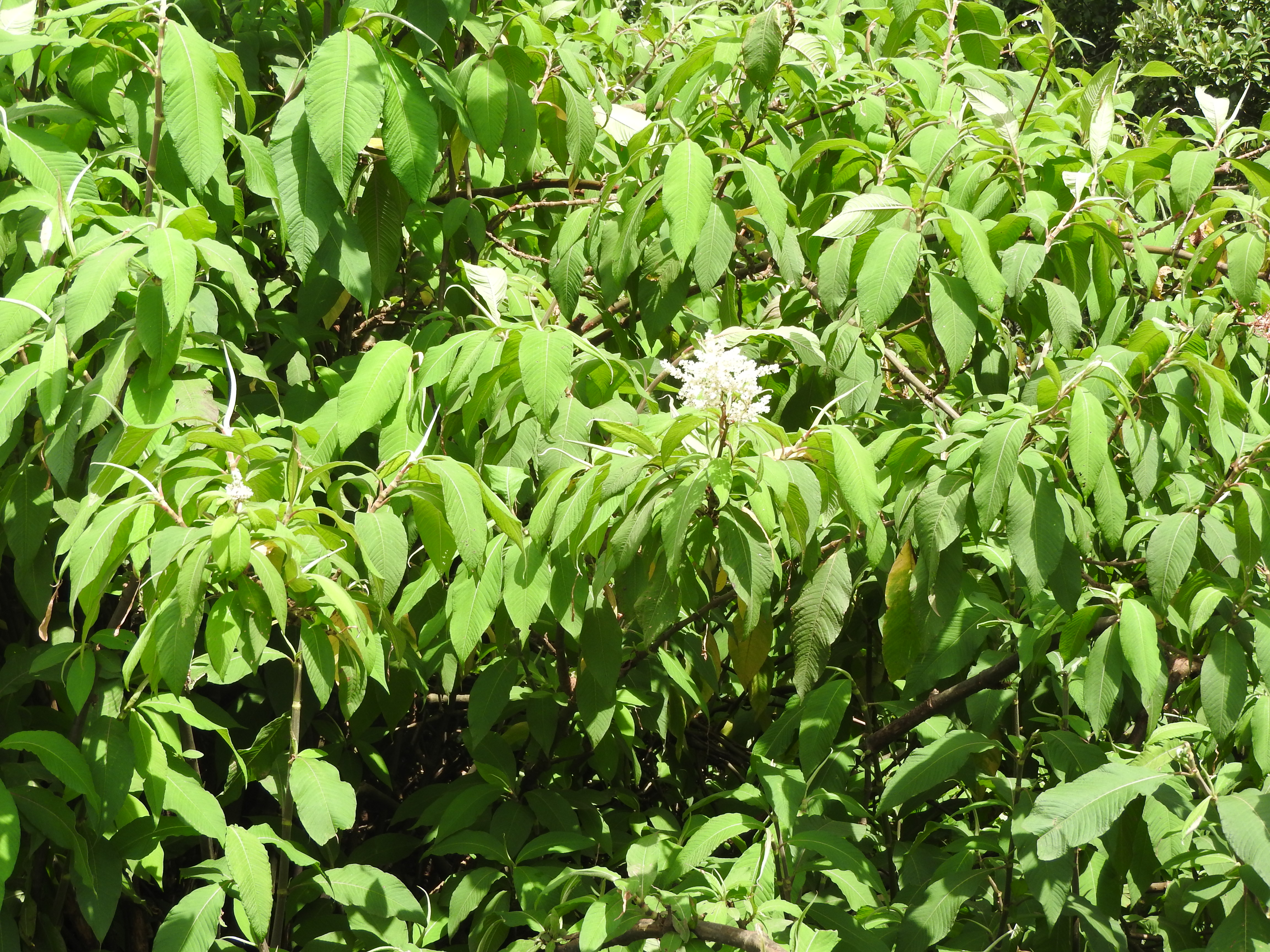
Himalayan Knotweed (Koenigia polystachya, syn. Persicaria wallichii)
Read the leaves. Himalayan knotweed is, in invasives.ie's words, "often confused with" the Japanese and giant knotweeds, and the guide's separator is leaf shape: long, lance-like leaves against Japanese knotweed's broad, flat-based spades. When it is not in flower, invasives.ie notes, it is also confused with Himalayan balsam, which makes this plant the centre of the whole confusion family.
This is the one entry on the page where the honest answer is not relief. Himalayan knotweed is listed on Part 1 of the Third Schedule of SI 477/2011 in Ireland, the same schedule as Japanese knotweed, so if this is your plant the legal position is analogous and the next step is the same. The RHS also lists it among regulated invasive non-native plants in the UK, though without naming the instrument, so neither do we. Our complete guide to Japanese knotweed in Ireland covers the Irish rules and treatment routes.
Also Confused, Less Often
The RHS knotweed page rounds out the garden confusions, and the Irish guide adds one shrub.
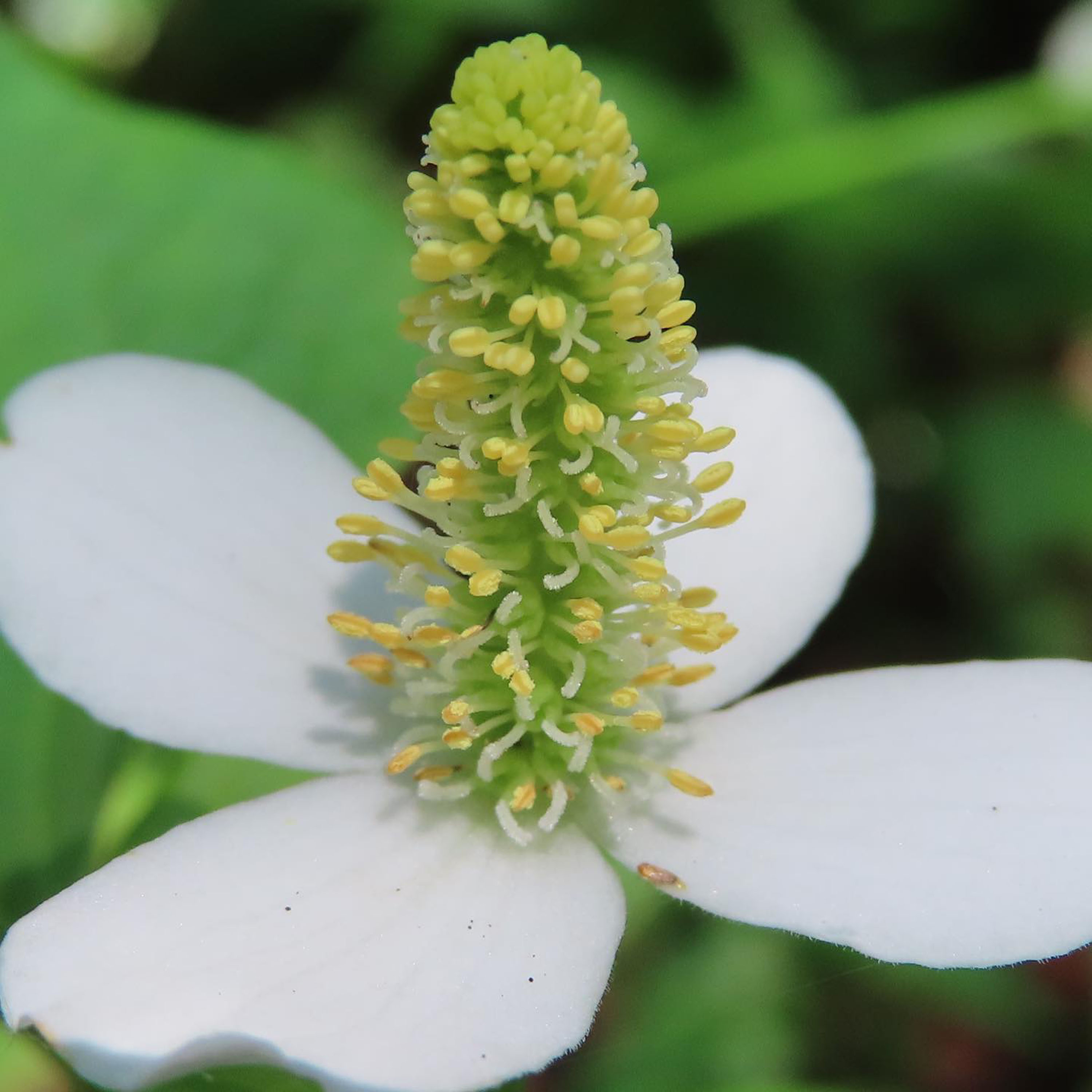
- Houttuynia (Houttuynia cordata). A wide-spreading herbaceous perennial reaching only about 30 cm, with pungently orange-scented, heart-shaped leaves and tiny yellow flowers in spikes ringed by four prominent white bracts, per the RHS. Rhizomatous and prone to extensive spreading.
- Himalayan honeysuckle (Leycesteria formosa). A vigorous deciduous shrub of 1.5-2.5 m with erect, sea-green stems; the stems are hollow, which is the overlap that worries people, but its pendulous white flowers with red-purple bracts and deep purple berries look nothing like knotweed (RHS).
- Small-headed knotweed (Persicaria microcephala). A dense, rhizomatous perennial of 0.5-1 m in knotweed's own family, carrying a "knotweed" common name while being a different plant entirely. Its oval foliage, reddish to dark green with brown and grey markings, carries small rounded heads of tiny white or pinkish flowers from midsummer into autumn (RHS).
- Red osier dogwood (Cornus sericea), red dog osier in the Irish guide. A wide-spreading, vigorous, suckering shrub to 1.8 m with deep to bright red winter stems, thin mid-green leaves, grey beneath, turning red in autumn, and creamy-white flowers in flat clusters to 7.5 cm across (RHS). invasives.ie notes that both it and bamboo are rarely encountered outside areas where they have been planted.
How to Tell in 30 Seconds
Work down this list and stop at the first yes.
- It is winding or climbing around a support: bindweed or Russian vine, not knotweed.
- The stems are woody and have been there for years: lilac, dogwood or Himalayan honeysuckle, not knotweed.
- The flowers are trumpets or pink bonnets: bindweed or Himalayan balsam, not knotweed.
- It is green and leafy in midwinter: bamboo, not knotweed, which is dead brown canes by then.
- The leaves are long and lance-like: not Japanese knotweed, but possibly Himalayan knotweed, which is regulated in Ireland too.
If nothing above applies, check the rule-in features in reverse: hollow, bamboo-like canes with red-purple speckling and conspicuous nodes; spade-shaped leaves with flat bases in a zig-zag; clusters of small creamy-white flowers in late summer; dead brown canes standing or lying on the ground in winter. Our identification guide walks through every feature, including the rhizome. Still unsure? The free AI identification tool at knotweedremoval.ie will check a photo of your plant in seconds.
Frequently Asked Questions
Which plant looks most like Japanese knotweed?
No official source ranks Irish confusions by frequency, so there is no honest "most common" answer. Structurally, bamboo is one of the two plants the official Irish guide names, because its canes and nodes echo knotweed's stems; among garden plants, the RHS names Russian vine, which shares knotweed's family and its sprays of tiny pale flowers. Each fails a simple test: bamboo is evergreen, and Russian vine climbs.
Is bindweed the same as Japanese knotweed?
No. Bindweed twines around other plants and structures and carries white or pale pink trumpet flowers from June to September; knotweed never climbs and flowers in small creamy-white clusters in late summer and autumn. The full feature checklist is in our Japanese knotweed identification guide.
Are any of these lookalikes also invasive in Ireland?
Two are. Himalayan balsam and Himalayan knotweed are both listed on Part 1 of the Third Schedule of SI 477/2011, the same schedule as Japanese knotweed, so planting or spreading them is an offence in the same way. The guide to Japanese knotweed in Ireland explains the regulations and penalties.
I have ruled out the lookalikes. What now?
Confirm the identification properly before doing anything else: our Japanese knotweed identification guide covers every feature by season. If knotweed is confirmed, the complete guide to Japanese knotweed in Ireland covers the law, property implications and treatment routes, including what not to do before treatment starts.
The Honest Answer for Most Readers
If your plant matched one of the tells on this page, you can let the knotweed worry go: a climbing bindweed, an evergreen bamboo or a woody lilac is a different plant, and most lookalikes are gardening nuisances rather than legal events. If nothing matched and the rule-in features did, the next step costs nothing: photograph the plant and run it through the free AI identification tool at knotweedremoval.ie. If knotweed is plausible, the guide to Japanese knotweed in Ireland covers the law, property questions and treatment. Knotweed deserves a serious plan, and the first step is knowing which plant you actually have.
Photo credits: "Calystegia sepium, whole plant" by NY State IPM Program at Cornell University, CC BY 2.0, via Wikimedia Commons; "Fallopia baldschuanica entwining around a wall" by noebse, public domain, via Wikimedia Commons; "Policeman's Helmet" by waferboard, CC BY 2.0, via Wikimedia Commons; "Rumex obtusifolius (Habitus)" by Christian Hummert (Ixitixel), CC BY 2.5, via Wikimedia Commons; "Phyllostachys vivax f. aureocaulis" by Franzo, CC0, via Wikimedia Commons; "Syringa vulgaris, Bulgaria" by Nedelin, CC BY 2.5, via Wikimedia Commons; "Koenigia polystachya, Sri Lanka" by Yercaud-elango, CC BY-SA 4.0, via Wikimedia Commons; "Houttuynia cordata inflorescence" by Fukufukurou, CC BY-SA 4.0, via Wikimedia Commons.


