Article
Japanese Knotweed in Ireland: The Complete Guide
Japanese knotweed in Ireland: the exact law and penalties, honest mortgage and property facts, season-by-season identification, and treatment that works.
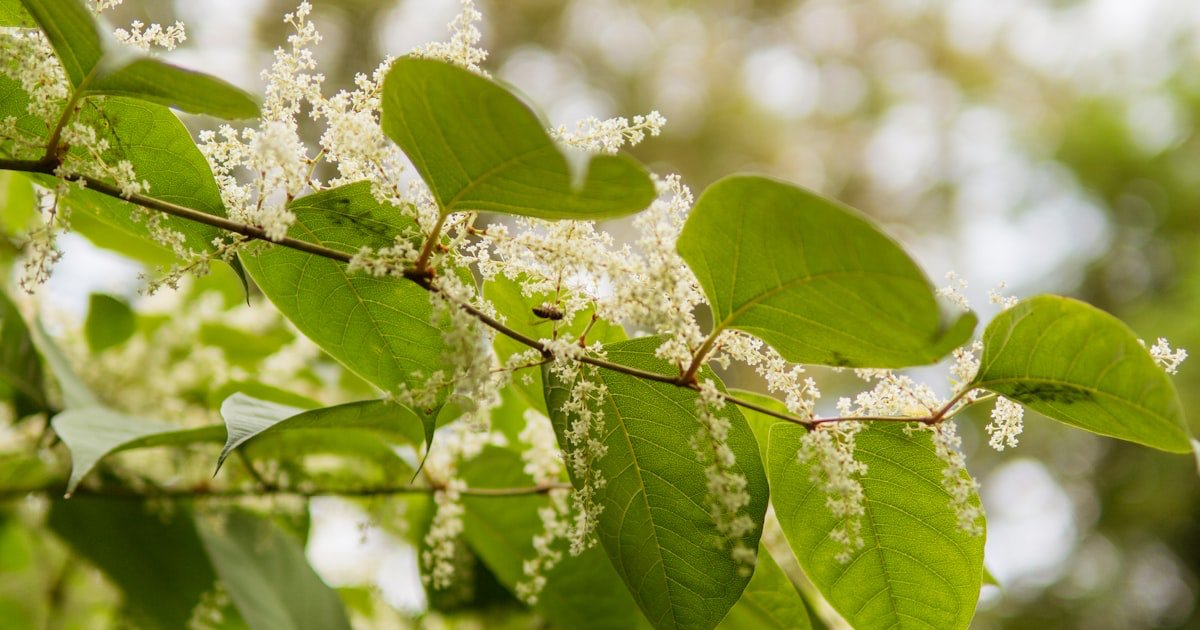
Japanese knotweed is now recorded in 768 of Ireland's 10-kilometre grid squares, and it is present in every county in the country, according to a 2017 Irish Times report. Allow it to spread, and you are committing a criminal offence under the European Communities (Birds and Natural Habitats) Regulations 2011. And yet the same official guidance that tells you this also records that there are no known cases in Ireland of a mortgage application being denied because of Japanese knotweed. Both facts are true, and most of what you will read online quietly drops one of them. This guide gives you the exact statute and its real penalties, an honest account of what the plant actually does to property, and a practical way to identify what is growing on your land. The aim is that you can make property decisions on evidence rather than headlines.
Key Takeaways - Japanese knotweed is recorded in 768 of Ireland's 10-km grid squares (National Biodiversity Data Centre, retrieved September 2026), and a 2017 Irish Times report described it as present in every county. - Under Regulation 49(2) of SI 477/2011, planting, spreading or allowing it to spread is an offence. Simply having it on your land is not, in itself, an offence. - Official Irish guidance records no known case of a mortgage being refused due to Japanese knotweed (invasives.ie). - Peer-reviewed UK research attributes 2% to 6% of surveyed property damage to knotweed, against 68% for buddleja (Fennell, Wade & Bacon, 2018). - Treatment takes at least three growing seasons. Cutting, strimming or composting the plant spreads it and can amount to an offence.
What Is Japanese Knotweed?
Japanese knotweed (Fallopia japonica, also sold and listed under its synonym Reynoutria japonica) is a tall, herbaceous perennial that was brought to Europe in the nineteenth century as an ornamental plant. The GB Non-Native Species Secretariat records its arrival in the Netherlands in 1849 and its first wild record in Great Britain in 1886. It arrived in Ireland the same way, as a desirable ornamental garden plant, and it has since moved well beyond gardens.
The plant's biology explains why it dominates its surroundings. Most plants are female and do not produce viable seed, as Offaly County Council's guidance puts it, and the GB clone is male-sterile, so it spreads by vegetative fragments rather than seed. A stem fragment or piece of rhizome displaced by a strimmer, a digger or a roadside mower can start a new stand. Nothing in its growth depends on a gardener's involvement, which is why it thrives on road verges and waste ground as much as in gardens.
In Ireland it is both common and officially widespread. The National Biodiversity Data Centre holds 8,087 records of the species, spread across 132 of the country's 50-km squares and 768 of its 10-km squares (retrieved September 2026). Dr Frances Giaquinto told the Irish Times in 2017 that the plant is present in every Irish county. The same statutory instrument that creates the offence also lists it in the Third Schedule as a species found "Throughout the State". In practice: if you own property in Ireland, knotweed is a realistic possibility rather than an exotic problem.
How to Identify Japanese Knotweed
Japanese knotweed is identified by a combination of features that change with the seasons, and no single feature is reliable on its own. Most misidentifications happen because people expect one dramatic "knotweed look" that exists for only a few weeks of the year. The sequence below, drawn from the Royal Horticultural Society, the GB Non-Native Species Secretariat and Offaly County Council, is what an established stand actually does across a full year in Ireland.
| Season | What you see |
|---|---|
| Spring | Reddish-purple shoots pushing up, often through last year's dead stems. |
| Summer | Bamboo-like stems typically around 2 m, with heart-shaped leaves in a zigzag pattern. |
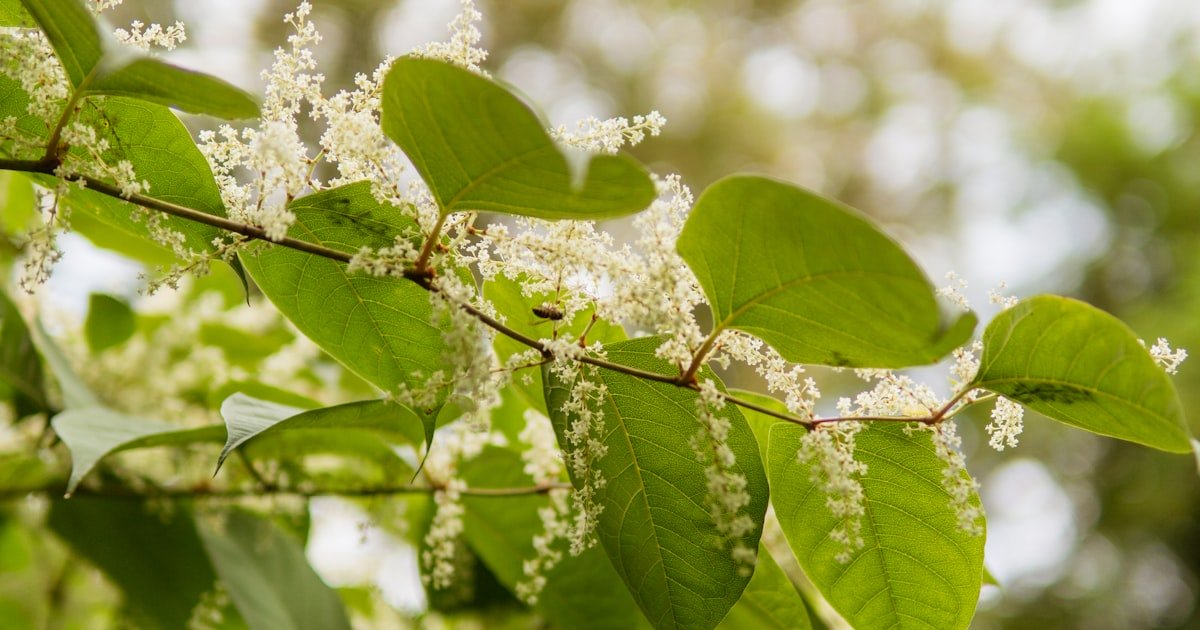
| Late summer and autumn | Creamy-white flower plumes, holding into autumn. |
| Winter | Dry, brown, bare canes standing in a visible thicket. |
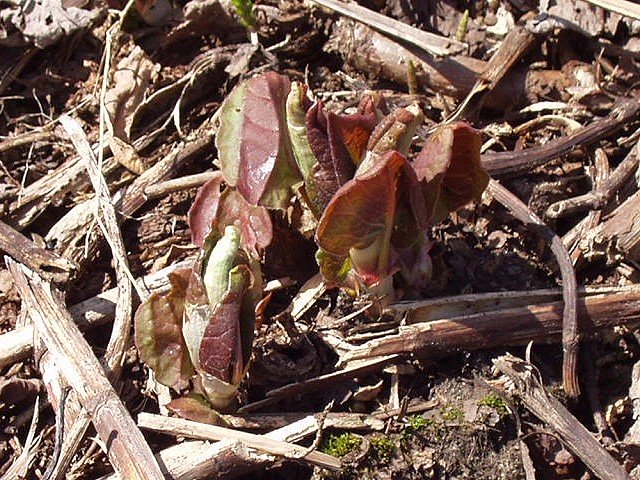
Spring: reddish-purple shoots push up through the soil, often through the remains of last year's canes.
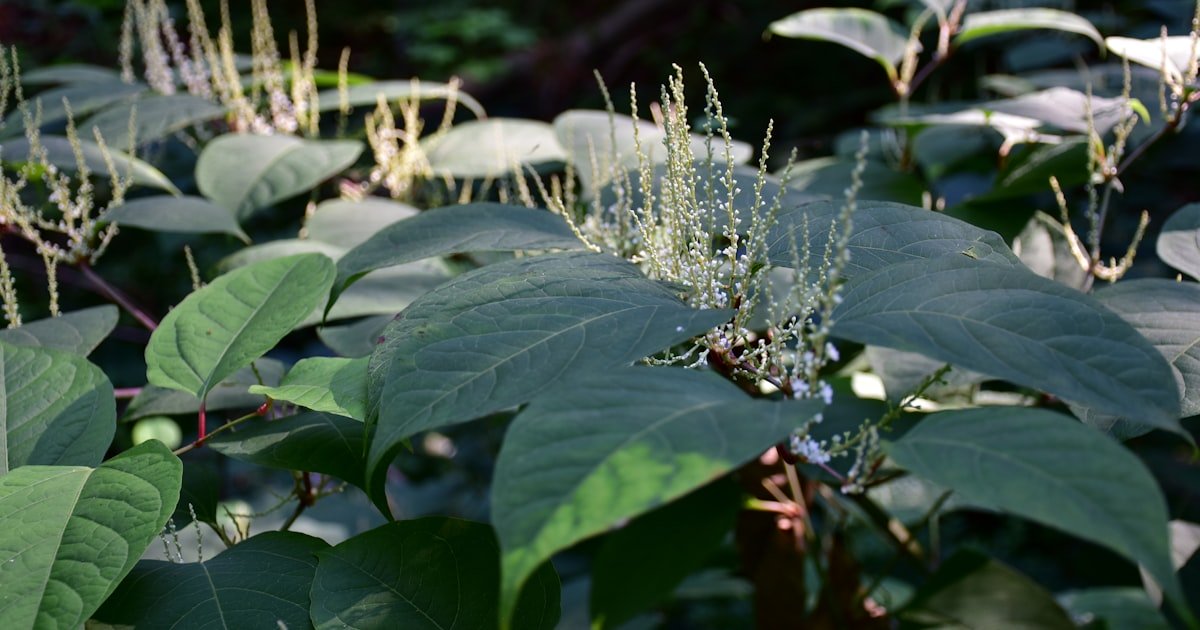
Summer: hollow, purple-speckled stems carry heart-shaped leaves in a zigzag pattern, followed by the creamy-white flower plumes.
Winter: the dead brown canes stay standing until new growth comes through in spring.
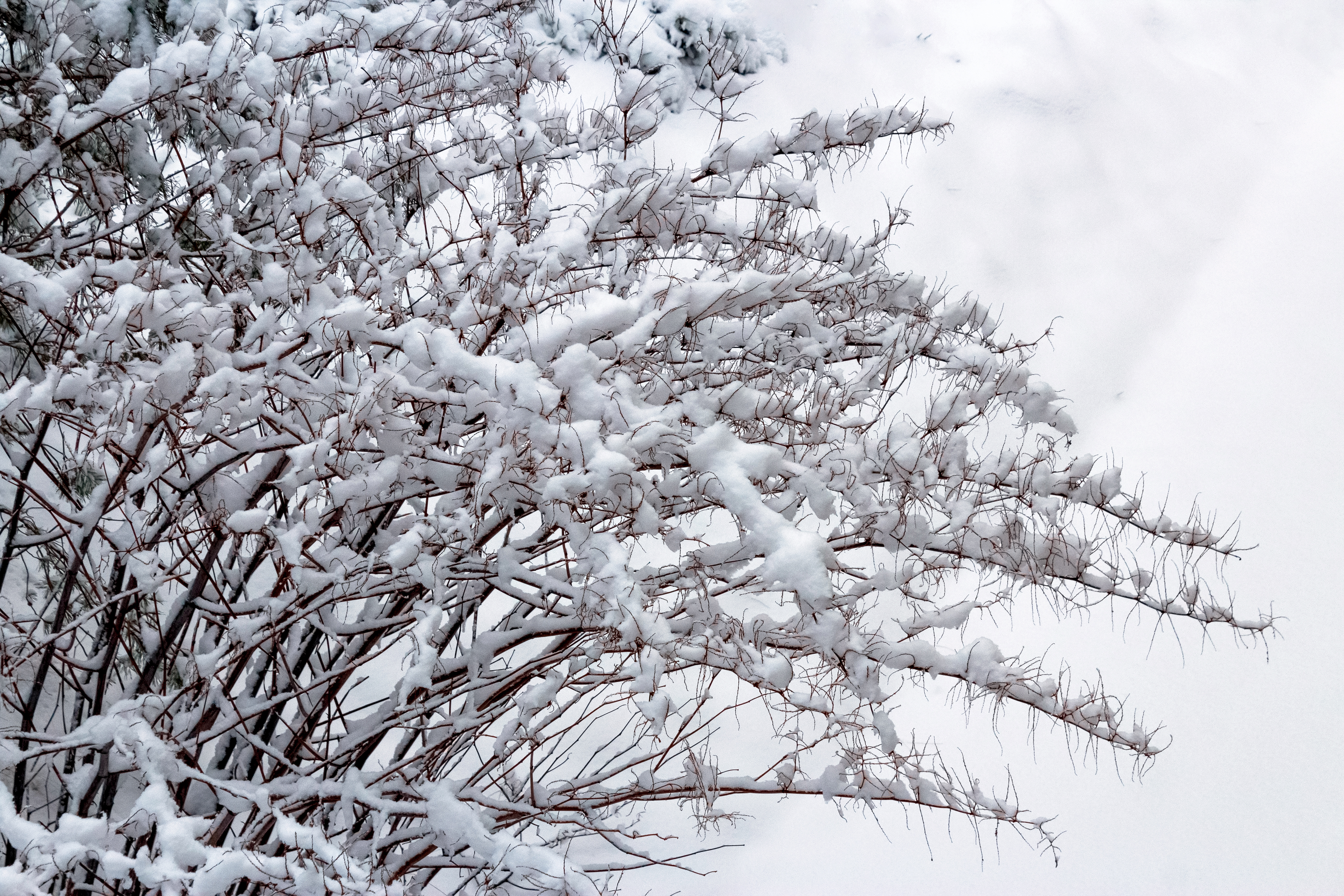
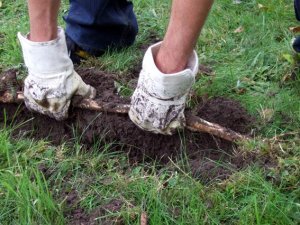
The part that matters most for identification, and for everything that follows in this guide, is below ground. Japanese knotweed spreads from a rhizome with a distinctive orange, carrot-like centre, and pieces as small as 1 cm can regrow into new plants, which is why treatment is measured in years rather than weeks and why cutting the visible growth achieves nothing. The full feature-by-feature process, rhizome included, is in our detailed identification guide, linked below.
Several common Irish plants are regularly mistaken for knotweed, including hedge bindweed, Himalayan balsam, broadleaf dock, bamboo and lilac, and confusing them matters: Himalayan balsam is itself an invasive listed species, while lilac and bamboo are harmless. If you want to work through the full identification process, our detailed Japanese knotweed identification guide covers each feature in order, and our plants commonly mistaken for Japanese knotweed walks through the lookalikes. The fastest way to an answer is a photo: the free AI identification tool at knotweedremoval.ie will check an image of your plant and tell you whether knotweed is a plausible match before you involve anyone else.
Is Japanese Knotweed Really as Dangerous as People Say?
No, the structural danger is heavily overstated, and the claim responsible for most of the fear has been withdrawn. The real risks are legal, financial and practical: the plant regrows stubbornly, controlling it is expensive, and its presence complicates sales. Those risks deserve to be taken seriously, and they are the reason this guide exists, but they are different risks from the ones most often described.
The single most influential claim in the knotweed panic is the "seven-metre rule": the idea that knotweed rhizome will travel 7 m from the visible plant and that property within that radius is at risk. The peer-reviewed study that finally measured this, Fennell, Wade and Bacon's 2018 analysis published in PeerJ, found that rhizome extends horizontally a mean of 1.4 m for small stands and 2.02 m for large stands, with no rhizome found beyond 4 m, and concluded that the seven-metre rule "is not a statistically robust tool". The 7 m figure, along with the companion claim that knotweed must be buried under 5 m of soil, traces back to a UK Environment Agency code of practice that has since been withdrawn. Irish contractors still quote those numbers, but they are citing a discredited document, not independent evidence.
The same study examined what knotweed actually does to buildings. In a case study of 68 properties, it found no damage to main buildings attributable to Japanese knotweed. When contractors and surveyors attributed damage to specific plants, knotweed was blamed in only 2% of cases by contractors and 6% by surveyors, compared with 68% for buddleja, 33% for trees and 75% for woody climbers. The widely repeated claim that the plant "grows through concrete" is, in the GB Non-Native Species Secretariat's words, "not supported by any published evidence": knotweed exploits existing cracks and weaknesses rather than creating them.
None of this makes the plant harmless. Knotweed can grow through damaged drainage, paving and boundary walls, and the GB Non-Native Species Secretariat puts the cost of eradicating it from UK construction sites at "well over £1,000 per square metre". Its presence can delay a sale and frighten buyers even when the survey finds no damage. An Irish ecologist publicly argued in the Irish Times that the threat is "vastly overstated", and the evidence above supports much of that argument. The balanced position, and the one the evidence actually supports, is that knotweed is a manageable problem that deserves a professional plan, not a reason to walk away from a property.
Japanese Knotweed and Irish Law: What SI 477/2011 Actually Says
The Irish offence is about spreading the plant, not owning it, and it is created by Regulation 49(2) of the European Communities (Birds and Natural Habitats) Regulations 2011 (SI No. 477 of 2011), in force since 21 September 2011. The exact wording matters, because most Irish web pages summarising this law get it wrong or cite the wrong instrument entirely:
"Save in accordance with a licence granted under paragraph (7), any person who plants, disperses, allows or causes to disperse, spreads or otherwise causes to grow in any place specified in relation to such plant in the third column of Part 1 of the Third Schedule, any plant which is included in Part 1 of the Third Schedule, shall be guilty of an offence."
Three elements of that wording deserve attention. First, the Third Schedule lists Japanese knotweed as present "Throughout the State", so the offence applies everywhere in Ireland, and unlike the equivalent UK legislation there is no "in the wild" qualifier limiting it to natural habitats. Second, the verb "allows" is what brings ordinary landowners into scope: the official invasives.ie control guide states that landowners "should take action to control this plant on your site" and warns that doing nothing "could be considered an offence by 'allowing' it to be dispersed or spread". Third, the words "save in accordance with a licence" and the defence in Regulation 49(3), available where a person "took all reasonable steps and exercised all due diligence", mean the law is aimed at conduct, not at the mere presence of the plant on your land.
The penalties are serious. Under Regulation 67(2), a person guilty of an offence is liable on summary conviction to a Class A fine (€5,000 under the Fines Act 2010) and/or up to six months' imprisonment, and on indictment to a fine of up to €500,000 and/or up to three years' imprisonment. Courts are also directed under Regulation 67(3) to consider the environmental injury caused.
Enforcement reality is more modest than the penalties suggest. The National Parks and Wildlife Service (NPWS) is the primary enforcement body, and local authorities have no direct enforcement role. A 2019 analysis in the Law Society Gazette noted that Japanese knotweed "has not been litigated in Ireland". The same analysis recorded that the Regulations' dealing and transport provisions under Regulation 50 remained "yet to be enacted". The Gazette also observed that a nuisance claim against a neighbour is unlikely to succeed absent physical damage to property.
There is genuine legal risk in ignoring knotweed or in spreading it through careless cutting, and the issue has reached the Dáil, with a written parliamentary question in April 2023. The Regulations have been amended several times since 2011, and the NPWS maintains a consolidated version if you need to check the text as it currently stands. But no Irish homeowner has been fined for having the plant to date, and the practical legal duty is the one invasives.ie states plainly: take reasonable steps to control it.
Selling or Buying: Knotweed and Irish Property and Mortgages
The headline for Irish homeowners is reassuring, and it comes from the official source: "While there are no known cases of mortgage applications being denied due to the presence of Japanese knotweed on site." That sentence appears in the invasives.ie control and management guide, and it should anchor every decision you make about an Irish property. Lenders in Ireland can and do ask questions, and a severe infestation will slow a transaction, but a documented refusal attributable to knotweed has not occurred.
The Irish professional framework exists and is maturing. The Society of Chartered Surveyors Ireland (SCSI) published the second edition of its "Japanese Knotweed: Property Information Paper" in September 2023, giving surveyors a standard framework for assessment. Ireland has no equivalent of the UK's mandatory TA6 property information form, so there is no standard knotweed question every seller must answer, though the Institute of Professional Auctioneers and Valuers called for UK-style disclosure as far back as 2017. In practice, conveyancing solicitors handle knotweed through direct enquiry and the survey process, which is why getting a proper survey matters more than any legal formula.
Cost is the honest counterweight to the reassurance. An Irish Times report from June 2017 put the cost of eradicating serious infestations at €30,000 to €40,000, and while that figure is nearly a decade old and reflects the worst cases rather than typical ones, it explains why the plant has a blighting effect on negotiations. For a buyer, it is a reason to price a management plan into the offer, not to walk away.
| Question | Ireland: what's documented | UK and Northern Ireland: what surveys show |
|---|---|---|
| Mortgage refusals | None known, per invasives.ie | UK: a 2017 OnePoll survey (n=100, a small sample) found 15% of reported deals fell through |
| Surveyor framework | SCSI Property Information Paper, 2nd ed., 2023 | UK: RICS guidance note (2022) with management categories, which relaxed the old 7 m rule |
| Seller disclosure | No Irish TA6-equivalent mandatory disclosure | UK: standard TA6 form includes a knotweed question |
| Value impact | No Irish study; one Irish Times figure of €30,000–€40,000 eradication cost for serious infestations (2017) | UK: OnePoll 2017 (n=100) reported an average 20% value drop; Northern Ireland: one reported Belfast case of a 40% drop |
UK figures deserve their labels. The UK Parliament received written evidence in December 2018 estimating that Japanese knotweed affects around 2% of UK properties and costs the UK economy roughly £170 million per year. The OnePoll survey behind the most-quoted numbers (average treatment £1,880, 15% of deals falling through, an average 20% value drop, 10% paying over £4,000) polled just 100 people who had dealt with the plant, so treat it as indicative at best.
The Belfast case, in which a property reportedly lost 40% of its value, is a single reported case in Northern Ireland, not a market-wide statistic. These numbers describe a different legal and lending environment; they are useful context, not a forecast of what happens in Ireland.
How Japanese Knotweed Spreads, and the Mistakes That Make It Worse
Japanese knotweed in Ireland spreads almost entirely through fragments moved by people, not through seed, which means most new infestations are the result of an identifiable human action. The RHS notes that sections of rhizome as small as 1 cm can regrow, and Offaly County Council's guidance warns that "even tiny pieces can regenerate". A stand that is left completely alone spreads slowly; a stand that meets a strimmer, a flail mower or a digger can be scattered across a site, a road verge or a whole neighbourhood in an afternoon.
That is why the never-list is absolute. Do not strim, mow, hedge-cut or flail Japanese knotweed. Do not cut the canes and leave them lying, and do not dig the plant out without a plan, because uncontrolled digging is one of the main ways fragments get moved. Do not put any part of the plant, including soil from around its roots, into a compost heap or a green bin: knotweed is controlled waste under the Irish Regulations, and invasives.ie is explicit that it must be disposed of only through licensed routes.
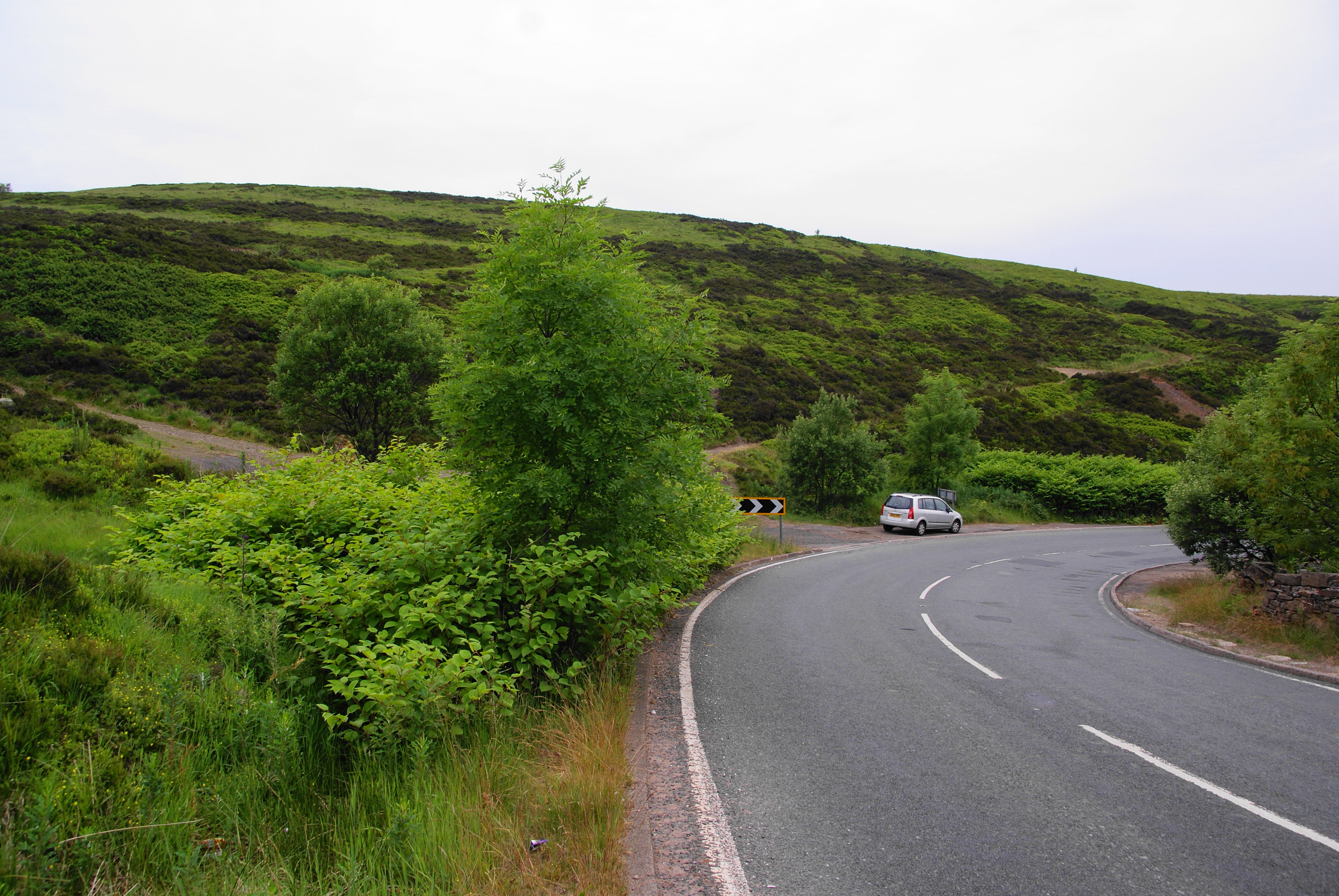
The two big spread pathways in Ireland are verge cutting and soil movement. Roadside and hedge-cutting machinery fragments stands along entire roads in a single run, which is how the plant colonises transport corridors, and the movement of infested soil during construction and landscaping plants it anew wherever that soil ends up. If you see knotweed on a road verge near your property, the useful response is a report to your county biodiversity officer or the National Biodiversity Data Centre, not a pair of shears.
Treatment and Removal in Ireland
Effective treatment means sustained herbicide application over at least three growing seasons, with licensed disposal of any waste, and there is no legitimate shortcut. Anyone promising that knotweed can be killed in one visit is promising something the evidence does not support.
Chemical control is the standard approach. Glyphosate-based herbicide is applied to the foliage or injected into the stems during the growing season, and herbicide use in Ireland is governed by the Sustainable Use of Pesticides Directive framework described by invasives.ie. The RHS confirms glyphosate as the practical option for garden situations and expects control to take at least three growing seasons. A four-year field trial by Swansea University, the most methodical test conducted to date, found that glyphosate-based treatment works but takes three to five years of repeat application, that a single treatment never succeeds, that spraying is most effective from summer into late autumn, and that disturbing the soil after control invites regrowth. The Swansea figures are UK research, but nothing in Irish conditions contradicts them.
The timeline that follows is what a realistic treatment programme looks like.
Two cautions from the official Irish guidance deserve emphasis. First, invasives.ie warns that three years with no visible regrowth does not mean the rhizome is dead: dormancy can last years, so monitoring must continue. Second, improper treatment, particularly cutting and digging, can worsen the infestation by spreading fragments. Excavation does have a role for development sites, but only as a controlled, licensed operation, never as an enthusiastic weekend with a digger, because infested soil is itself a regulated vector material under the Third Schedule.
Disposal is where well-intentioned owners most often break the law. Under Regulation 50 and the Third Schedule's vector-material provisions, invasives.ie states that a licence is required to remove and dispose of Japanese knotweed, including infested soil and spoil. Acceptable routes are a deep-fill licensed landfill that has confirmed it accepts knotweed waste, or on-site burial with authorisation from your local authority. The NPWS Licencing Unit (telephone 01 888 3298 or 01 888 3275) handles licence queries, sightings can be logged with the National Biodiversity Data Centre, and suspected wildlife crime can be reported through npws.ie. UK codes of practice do not govern in Ireland, so check Irish requirements rather than importing UK advice.
For budgeting, the UK research by Fennell and colleagues put typical UK residential remediation at £2,000 to £5,000, which is a more realistic anchor than the €30,000-plus figures attached to the most severe Irish cases. Whatever the number for your site, it starts with a professional survey that maps the infestation, confirms the identification and sets out a treatment plan.
Frequently Asked Questions
Is it illegal to have Japanese knotweed on my property in Ireland?
No. The offence under Regulation 49(2) of SI 477/2011 is planting, dispersing, spreading or allowing the plant to grow, not owning it. Simply having knotweed on your land is not an offence, but ignoring it can be, because invasives.ie warns that doing nothing "could be considered an offence by 'allowing' it to be dispersed or spread". Taking reasonable steps to control it is both the legal answer and the practical one.
Will Japanese knotweed stop me getting a mortgage in Ireland?
There are no known Irish cases of a mortgage being denied because of knotweed, according to invasives.ie. Lenders may ask for a surveyor's assessment or an evidence of treatment plan, and a severe untreated infestation will complicate matters, but a documented refusal has not occurred. UK survey figures suggesting widespread problems come from a different lending market and a very small sample.
Do I have to declare Japanese knotweed when selling a house in Ireland?
Ireland has no mandatory TA6-equivalent disclosure form with a standard knotweed question, as the Law Society Gazette has noted. In practice, buyers' solicitors ask direct questions, and surveyors work to the SCSI's 2023 property information paper. Answering honestly and having a treatment record in place is the strongest position to sell from.
Can I remove Japanese knotweed myself?
Partly, and with care. The RHS confirms that gardeners can treat knotweed with glyphosate over at least three growing seasons, so a domestic-scale stand on your own land can be self-managed. What you cannot do yourself is dispose of the waste: removal and disposal require a licence, and landfills will only accept the material if they are licensed for it. If the stand is large, near a boundary or part of a property transaction, a professional survey is the sensible starting point.
Can I cut, strim or compost Japanese knotweed?
No to all three. Strimming, mowing, hedge-cutting and flailing fragment the plant and spread it, which is the very conduct Regulation 49 prohibits, and fragments as small as 1 cm can regrow. Composting or green-binning any part of the plant is prohibited because knotweed is controlled waste. If canes must be cut for access, they stay on site, dry and are disposed of through a licensed route.
How long does Japanese knotweed treatment take?
At least three growing seasons of herbicide treatment, and commonly three to five years, per the RHS, invasives.ie and the Swansea University field trial. Three years without visible regrowth is not confirmation that the rhizome is dead, because it can lie dormant, so monitoring continues after treatment ends.
My neighbour has Japanese knotweed. What can I do?
Start by talking to them, since many owners simply do not know what the plant is, and share the invasives.ie control guide, which tells landowners to take action. The NPWS is the enforcement body for the Regulations, and the Law Society Gazette has noted that an Irish nuisance claim is unlikely to succeed without physical damage to your property. An Irish Times gardening Q&A from December 2025 works through the practical steps for raising the issue with a neighbour.
Does Japanese knotweed really grow through concrete?
No. The GB Non-Native Species Secretariat states that the claim is "not supported by any published evidence". Knotweed exploits cracks and weak points that already exist, in drains, paving and old masonry, rather than forcing its way through sound material, and the largest peer-reviewed study found knotweed blamed for a small fraction of the damage attributed to other plants.
Where That Leaves You
Japanese knotweed in Ireland is a common, legally significant and entirely manageable plant, and the evidence supports calm rather than panic. The essentials are straightforward.
- Confirm the identification before anything else: several harmless plants are routinely mistaken for knotweed.
- Do not cut, strim, mow or compost it; fragments spread it and doing so risks an offence under Regulation 49.
- Know the real law: spreading or allowing spread is the offence, with penalties up to €500,000 and three years on indictment, but possession is not an offence and there have been no Irish prosecutions to date.
- Take the property picture honestly: no known Irish mortgage refusals, but real treatment costs and a slower sale if the plant is untreated.
- Budget years, not weeks: three or more growing seasons of treatment, licensed disposal, and monitoring after regrowth stops.
Your fastest next step is the free AI photo identification tool at knotweedremoval.ie: upload a photo of the plant and suspected rhizome, and get an immediate read on whether knotweed is what you are dealing with. From there, a professional survey turns worry into a plan.
Photo credits: "Reynoutria japonica, new shoots in spring, Aomori, Japan" by Aomorikuma (2004), CC BY-SA 3.0 with GFDL, via Wikimedia Commons. "Heavy snow on Japanese knotweed branches in Tuntorp" (29 December 2021, Sweden), CC BY-SA 4.0, via Wikimedia Commons. "Fallopia japonica rhizome" by Klarerwiki (2007), CC BY-SA 2.0 DE, via Wikimedia Commons. "Japanese knotweed by the A640" by Bill Boaden (2010), CC BY-SA 2.0, via geograph.org.uk and Wikimedia Commons. The remaining photographs, including the hero image, are from Unsplash under the Unsplash Licence, with no attribution required.


