Article
How to Identify Japanese Knotweed: Season by Season
Japanese knotweed identification for Ireland: the 30-second check, plus stems, leaves, flowers and rhizomes explained season by season, with photos throughout.
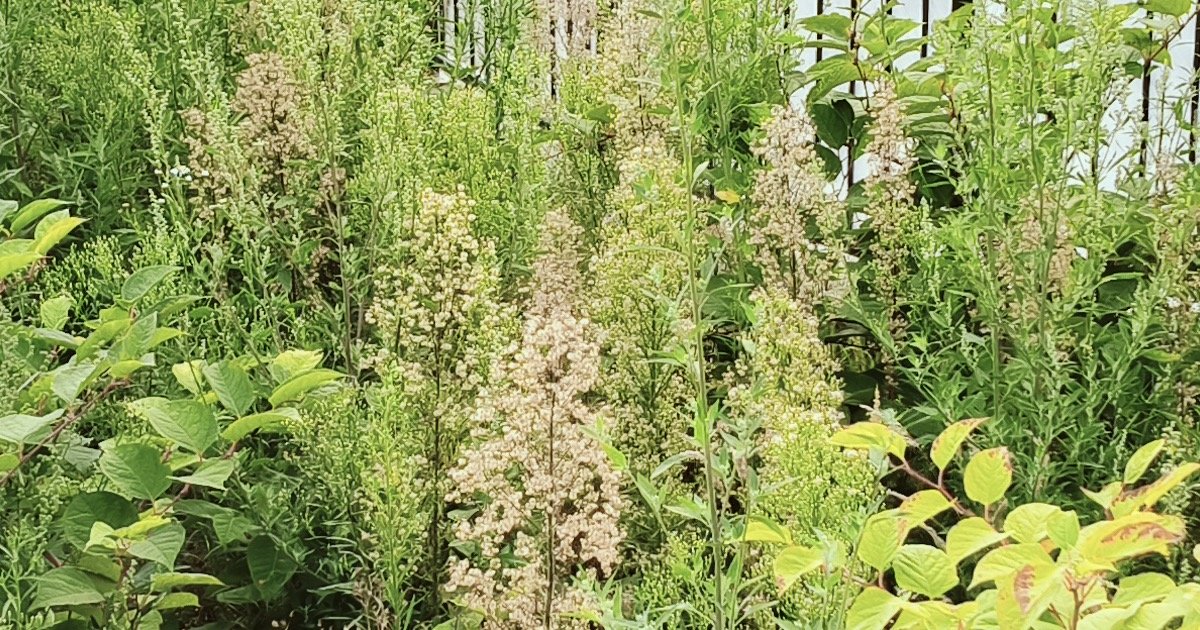
You are standing in the garden looking at a plant, and you want an answer now. This page is a feature-by-feature Japanese knotweed identification check you can run in a few minutes, in any season, with no equipment and no digging. Every description is drawn from named official sources: invasives.ie and Offaly County Council in Ireland, and the Royal Horticultural Society (RHS) and GB Non-native Species Secretariat (GB NNSS) in the UK. The wider picture, meaning the law, property implications and treatment, is covered in our guide to Japanese knotweed in Ireland; this page does one job, which is helping you decide what you are looking at.
Key Takeaways - Leaves grow one per node, alternating along the stem in a zigzag pattern; each leaf is spade-shaped with a flat base, usually up to about 14cm long, and never heart-shaped. - Stems are hollow and bamboo-like, with conspicuous nodes and red-purple speckles; mature stands typically reach about 2m, sometimes 3m. - In winter, dead brown cane-like stems remain standing or lying on the ground; in spring, red-purple "asparagus tip" shoots push up through them. - Flowers appear from late summer into early autumn as clusters of small creamy-white flowers; in Ireland they do not set viable seed, as most plants are female. - If two or more of these features match, treat the plant as knotweed until a professional survey says otherwise, and do not cut, strim or dig it.
The 30-Second Check: The Fastest Way to Screen for Knotweed
Three checks do most of the work of ruling knotweed in or out, and together they take about half a minute. Run them in this order.
1. The leaf attachment. Knotweed leaves grow one at each node, alternating left and right, so the leaves trace a visible zigzag down the stem. The RHS (UK) describes leaves "arranged in a zig-zag pattern along the stems", and invasives.ie, Ireland's official invasive species guidance, names leaf shape and the zig-zag arrangement as the two features that separate knotweed from the plants it is mistaken for.
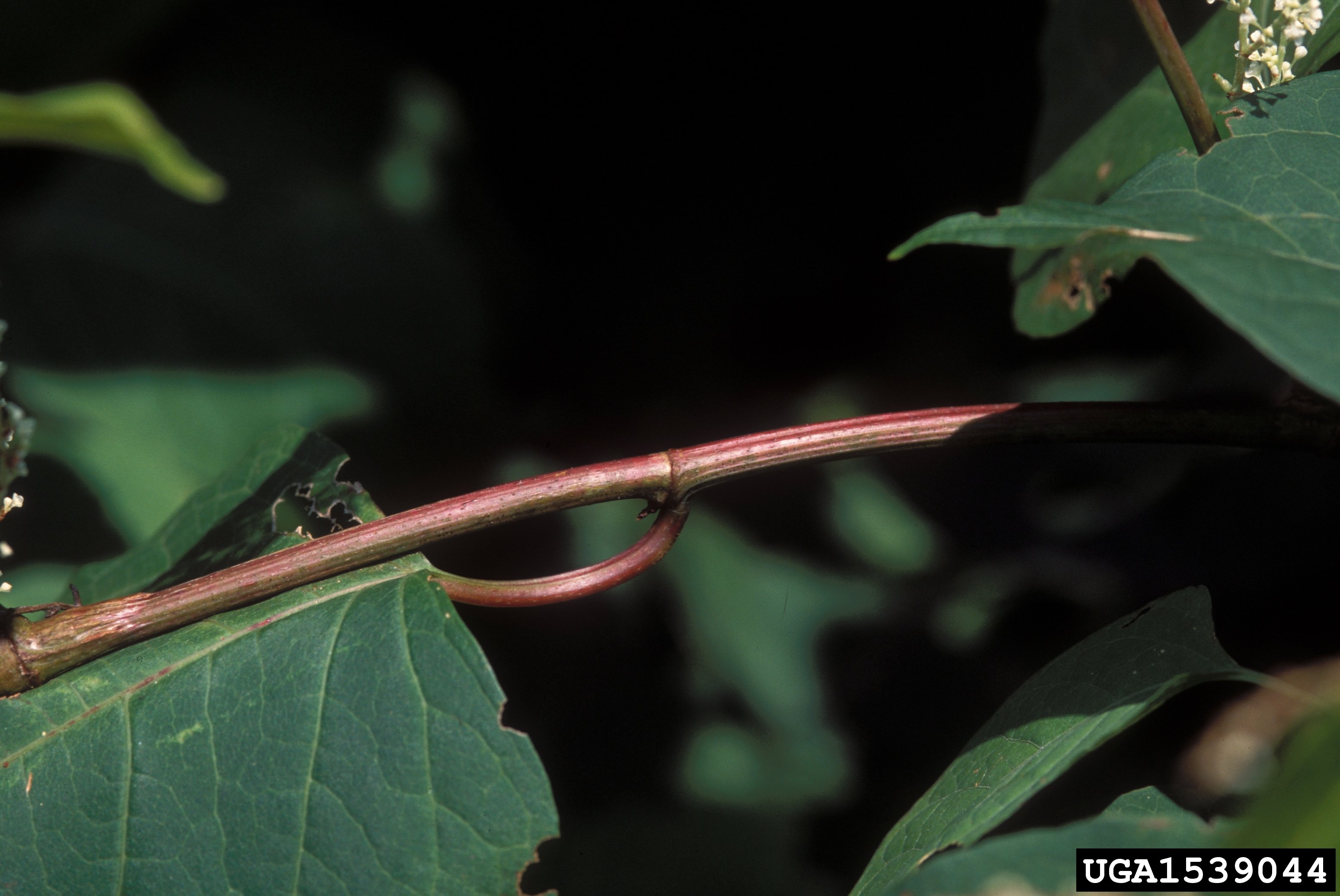
2. The stem. The stem should be hollow and bamboo-like, with conspicuous nodes and red or purple flecks. The RHS, invasives.ie and Offaly County Council all describe the stem in these same terms. Each cue on its own appears in other plants; the three together point strongly toward knotweed.
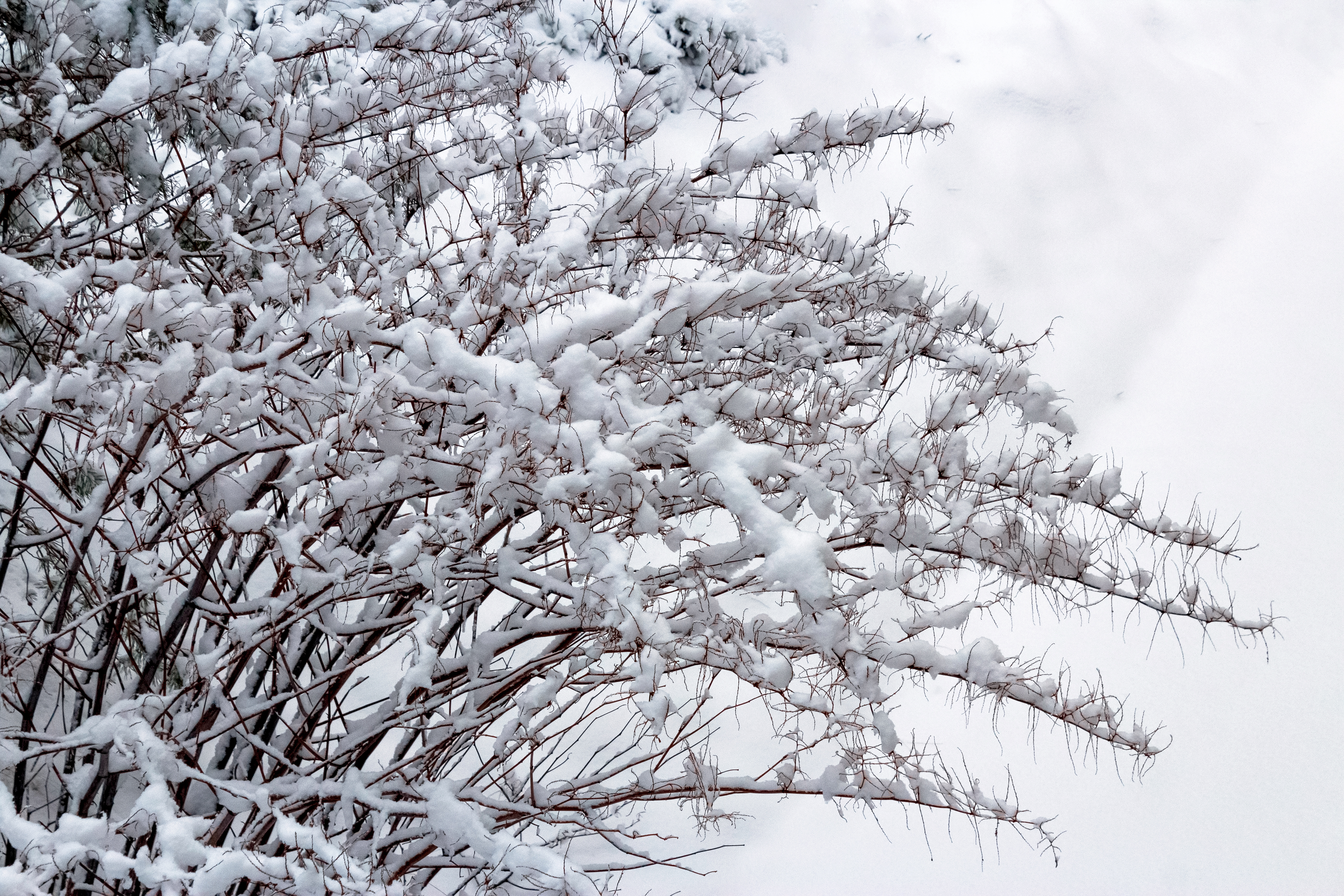
3. The season signature. Dead brown canes from last year, standing or lying on the ground, with new red-purple shoots coming through in spring, is a combination bamboo never produces, because bamboo stays green and leafy all winter while knotweed dies back completely (RHS; invasives.ie).
If the plant ticks some of these boxes but you are still not sure, get a second opinion in under a minute: upload a photo to the free AI photo identification tool before you touch the plant.
Knotweed Stems: Hollow, Speckled and Bamboo-Like
A Japanese knotweed stem is hollow, bamboo-like, and marked by conspicuous nodes and red-purple speckling. The RHS (UK) describes "bamboo-like stems" with "reddish-purple speckling, conspicuous nodes and hollow centres". invasives.ie describes bamboo-like hollow stems with a green stem carrying red/purple flecks. Offaly County Council (page updated March 2026) describes the same hollow stems with distinct purple speckles. Three official sources describing the same stem the same way makes this one of the most reliable checks on this page.
Stands usually reach about 2m (6.5ft) tall and hit full height in late summer, according to the RHS. The GB NNSS (UK) gives "typically about 2m", and the Irish sources allow up to 3m (invasives.ie; Offaly County Council). Mature stems may arch over at the top, and the RHS warns that small clumps can quickly become dense thickets.
Winter changes the stem but does not remove the evidence. The RHS records that stems die back in winter, leaving sections of dry, brown stems scattered on the ground, sometimes remaining upright in sheltered spots, while the root system stays alive but dormant. invasives.ie adds that the dead brown cane-like stems often still carry evidence of browned flowers. Those persistent canes make winter a genuinely good season for identification.
Knotweed Leaves: Spade-Shaped and Set in a Zigzag
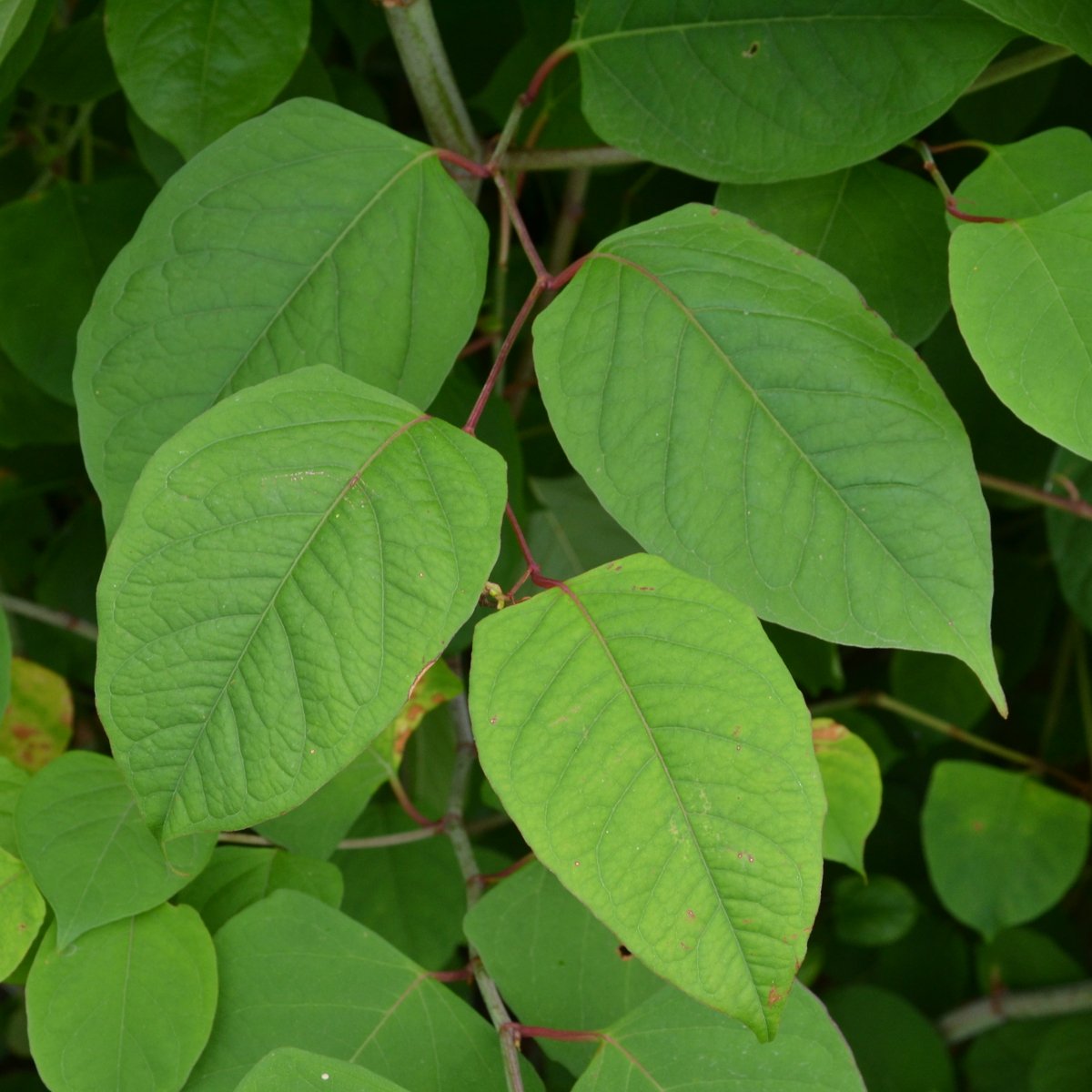
A knotweed leaf is spade-shaped with a flattened base, usually grows to about 14cm (5.5in) long, and sits one per node, alternating along the stem in a zigzag. The RHS (UK) describes "spade-shaped green leaves with flattish bases". The GB NNSS (UK) is more precise about the base: "large, roughly triangular leaves with truncate (not cordate [heart-shaped]) bases". In plain terms, the bottom of the leaf is flat or squared-off where it meets the stalk, and it is explicitly not heart-shaped.
That flat base is one of the fastest ways to rule knotweed out. Several of the plants knotweed gets compared with, including hedge bindweed and common lilac, have genuinely heart-shaped (cordate) leaf bases; knotweed never does.
The arrangement check is just as quick. Because one leaf grows from each node and the nodes alternate sides, the leaves form a zigzag line down the stem that you can see from a few paces away. invasives.ie treats leaf shape plus the zig-zag arrangement as the decisive pair of features, so if either half of that pair fails, look again before concluding knotweed.
Knotweed Flowers: Clusters of Small Creamy-White Flowers
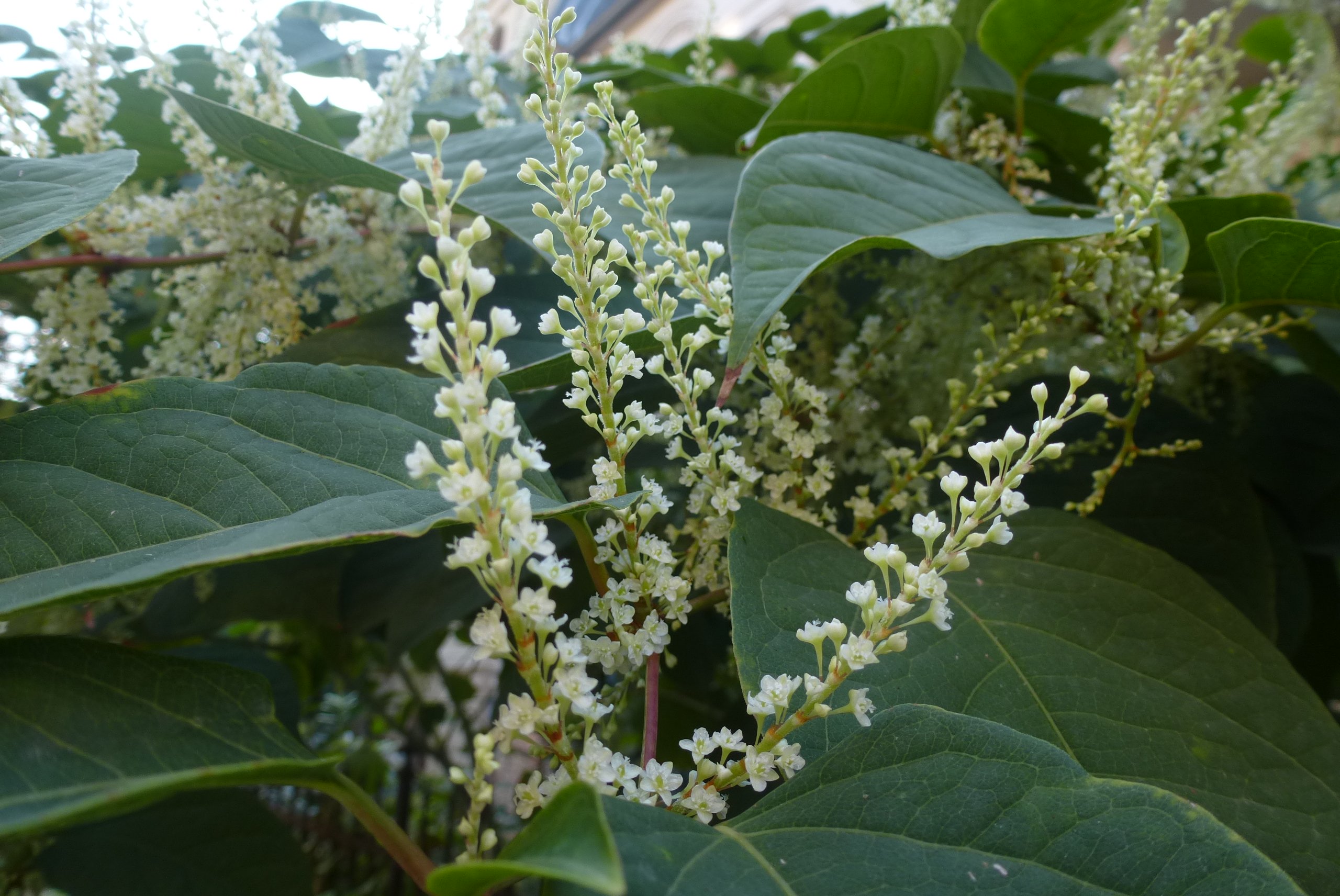
From late summer into early autumn, Japanese knotweed carries clusters of small creamy-white flowers toward the tips of the stems. The RHS (UK) notes the flowers are produced in late summer and early autumn; invasives.ie and Offaly County Council both describe clusters of small creamy white flowers emerging in late summer. In September the plumes sit on top of the full-height stand.
The important point for Ireland is what those flowers do not do: they do not produce seed. Offaly County Council notes that most plants are female and do not produce viable seed, and the GB NNSS (UK) records that UK plants are a male-sterile clone producing no seed, though they can hybridise with other Fallopia species. So a flowering stand in an Irish garden is not about to seed itself across the boundary. Spread happens below ground and by fragments, mainly through infested soil being moved and cut material from hedge or verge cutting.
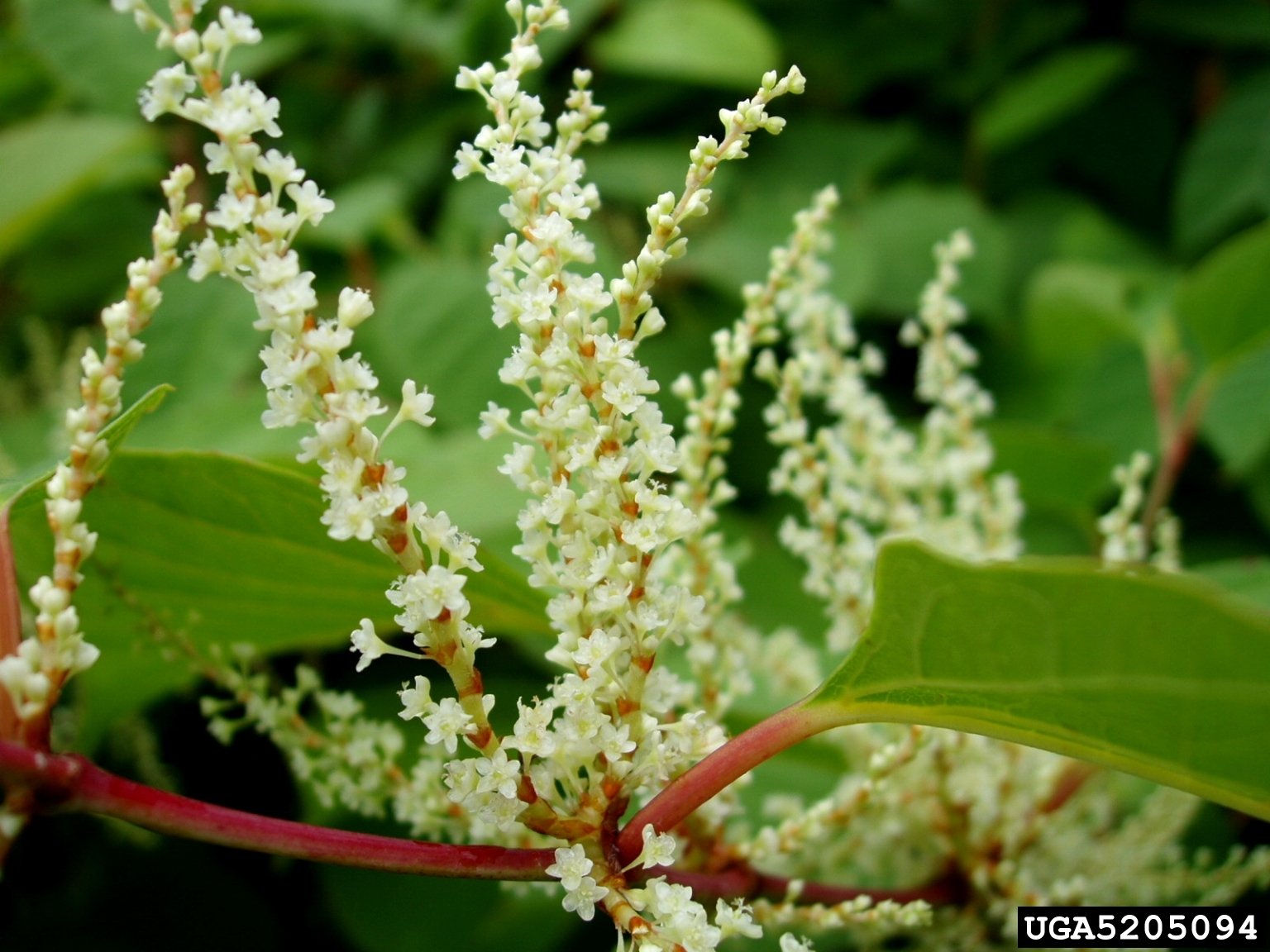
Seen from a distance, the flowers change the whole silhouette of the stand, sitting as pale plumes above the arching canes.
Spring Shoots: Red-Purple Shoots Through Last Year's Canes
In spring, rounded pink buds form at ground level and reddish-purple shoots emerge from them, often pushing straight up through the dead canes of previous years. The RHS (UK) describes the sequence exactly: "rounded pink buds form at ground level and from these reddish-purple shoots emerge". invasives.ie describes small red buds that develop into "asparagus tip" shaped stems, and that asparagus wording is the one used in official Irish guidance.
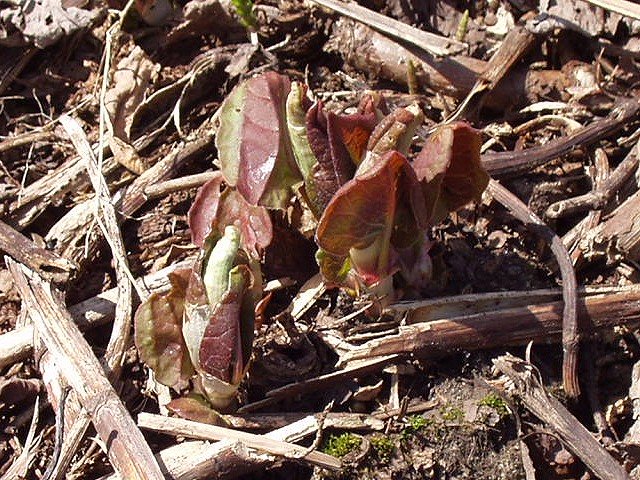
Spring is the season that generates the most identification queries, and the reason is that for a few weeks the plant shows two identities at once: last year's dead brown canes and this year's fleshy red-purple shoots. If you have only ever seen the summer plant, the spring version can look like an entirely different species. The shoots also grow quickly once they start. The RHS notes that the soft shoots grow rapidly, so a low cluster of red tips in April is a dense green stand by late summer.
The Rhizome: What Knotweed Looks Like Below Ground
Below ground, knotweed carries thick, woody rhizomes that look like tree roots: dark brown on the outside, orange just beneath the surface, and commonly with an orange centre that snaps like a carrot. The RHS (UK) describes rhizomes that become "thick and woody, looking a lot like tree roots", with orange colouring beneath the dark brown outer layer. invasives.ie describes the rhizome as "commonly with an orange centre that snaps easily like a carrot when bent". That orange inside is the most distinctive below-ground sign the plant has.
The scale of the system matters for what you do next. The RHS notes the rhizome system can extend more than 1m down. Field measurements give the fuller picture: a UK study by Fennell, Wade and Bacon, published in PeerJ in 2018, measured rhizome spread around infestations and found a mean horizontal spread of 1.4m around small stands and 2.02m around large stands, mean depths of 1.02m and 1.64m respectively, a single maximum depth of 3.2m, and no rhizome in the study beyond 4m (Fennell et al., 2018).
The rhizome is also why you should never dig up a suspect plant to confirm it. The RHS records that rhizome sections as small as 1cm can regrow into new plants, so a hole dug out of curiosity can leave fragments that each become a new stand. Identification from the stems, leaves and seasonal signs above ground is enough for a first assessment. If genuine doubt remains, a photo check or a professional survey settles it without disturbing the soil.
Japanese Knotweed Month by Month
The calendar below condenses the seasonal descriptions from the sources cited above, the RHS, GB NNSS, invasives.ie and Offaly County Council, into a single strip. Whatever month you are reading in, this is what a knotweed stand should be doing.
| Months | What you should see |
|---|---|
| March to April | Rounded pink buds at ground level; reddish-purple "asparagus tip" shoots pushing up, often through last year's dead canes |
| May to June | Rapid soft growth; green canes forming and clumps thickening |
| July to August | Stands near full height, typically about 2m and sometimes 3m; hollow speckled canes, spade-shaped zigzag leaves, tops arching |
| September to October | Clusters of small creamy-white flowers toward the stem tips |
| November | Growth stops; foliage dies back; stems turn to dry brown canes |
| December to February | Dead brown canes standing or lying on the ground, often with browned flower remnants; rhizome alive but dormant below |
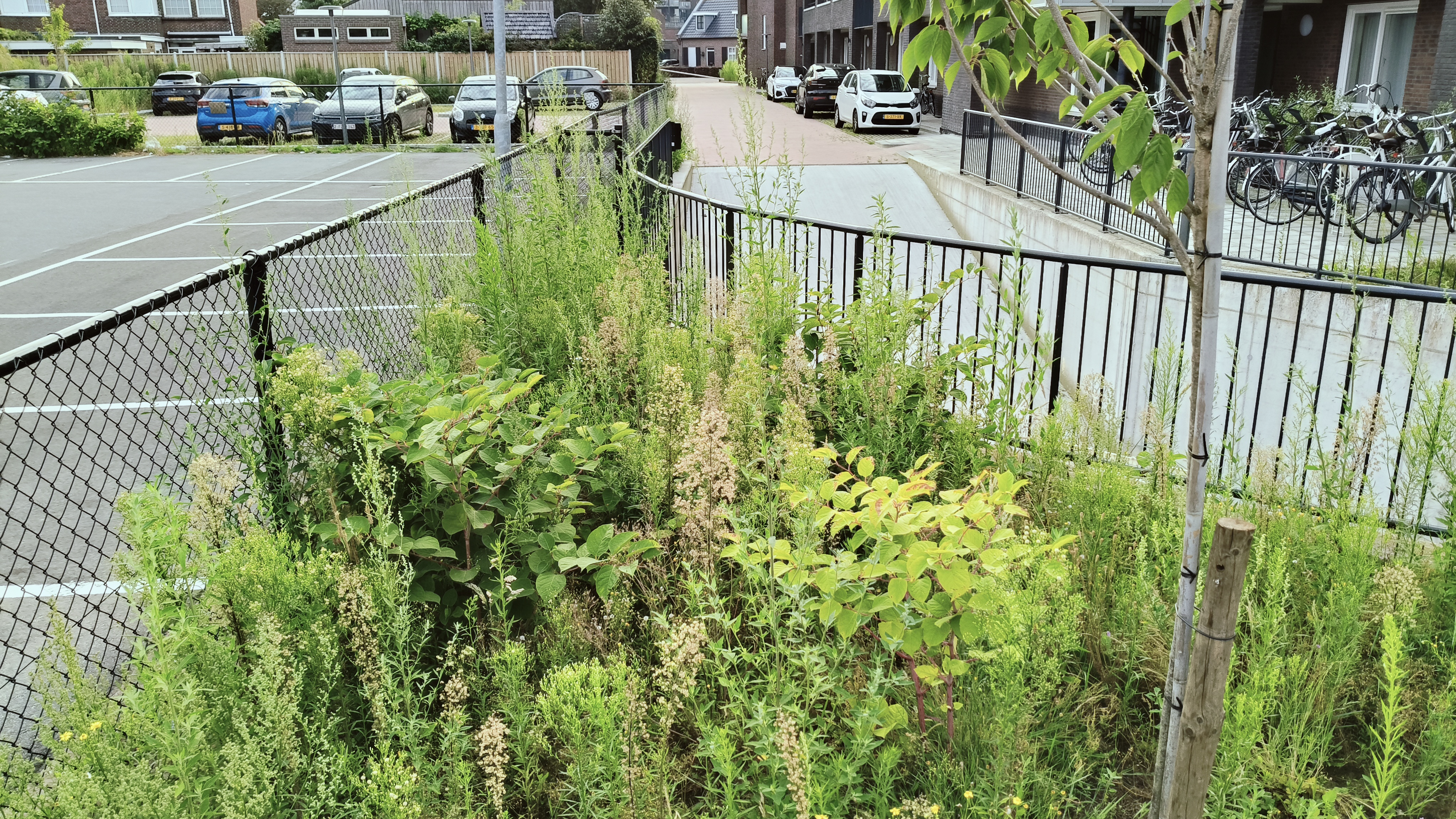
By late summer a mature stand is a wall of arching canes, which is the form most people picture when they hear the name.
What If It Is Not Knotweed?
If the leaf base is heart-shaped, the plant twines or climbs, or the flowers are large and pink, you are probably looking at something else. invasives.ie records that knotweed is mistaken for bamboo and red dog osier (Cornus sericea), both rarely encountered outside areas where they have been planted, and it repeats that leaf shape and the zig-zag arrangement are the distinguishing features. The RHS (UK) lists the confusions it sees in gardens: Russian vine, Himalayan honeysuckle, Houttuynia cordata and Persicaria microcephala.
Himalayan balsam also belongs in this conversation, because invasives.ie contrasts it directly with knotweed: balsam has finely serrated, knife-like leaf edges, pink bonnet-shaped flowers and fragile stems, while knotweed has smooth-edged leaves on sturdy canes. One caution if you land on balsam: it is itself a Third Schedule invasive species under SI 477/2011 in Ireland, so a correct identification still matters. Each of these plants, and how to tell every one of them from knotweed feature by feature, is covered in Plants Mistaken for Japanese Knotweed.
Japanese Knotweed Identification: Frequently Asked Questions
What does Japanese knotweed look like in spring, summer and winter?
In spring, rounded pink buds appear at ground level followed by red-purple "asparagus tip" shoots, often coming up through last year's canes (RHS; invasives.ie). In summer, the plant forms dense stands of hollow, bamboo-like, red-purple-speckled canes, typically about 2m and sometimes up to 3m, according to the RHS and GB NNSS (UK). The canes carry spade-shaped zigzag leaves (RHS; Offaly County Council). In winter, dead brown cane-like stems stand or lie on the ground, often still showing browned flowers, with the root system alive but dormant beneath (RHS; invasives.ie).
Can I identify Japanese knotweed from a photo?
In most cases, yes, if the photo shows the right features. The features that carry well in a photo are the ones invasives.ie names as decisive: leaf shape and the zig-zag arrangement. Shoot a close-up of a leaf where it meets the stem, a section of stem showing nodes and speckles, and the whole plant for height and form. A single flower close-up is weaker evidence than a leaf-and-stem shot, and knotweed does not twine, climb or produce large pink flowers, so a photo showing any of those points away from it. Where real doubt remains, a professional survey settles it.
What does Japanese knotweed root look like?
The roots are thick, woody rhizomes that look like tree roots: dark brown outside, orange beneath the outer layer, and commonly with an orange centre that snaps easily like a carrot when bent (RHS; invasives.ie). Do not dig a plant up to check. The RHS records that rhizome sections as small as 1cm can regrow into new plants, so a check-by-digging can multiply the problem rather than answer the question.
Does Japanese knotweed flower or spread by seed in Ireland?
It flowers, producing clusters of small creamy-white flowers from late summer into early autumn, but it does not spread by seed to any meaningful extent in Ireland (RHS; invasives.ie; Offaly County Council). Offaly County Council notes that most plants are female and do not produce viable seed, and the GB NNSS (UK) records that UK plants are a male-sterile clone. Spread happens through fragments: infested soil moved around, and cut material from hedge or verge cutting.
If Two or More Features Match
A plant showing two or more of the tells in this guide, whether the zigzag spade-shaped leaves, the hollow speckled canes, the dead winter canes, or the creamy-white late-summer flowers, should be treated as knotweed until a professional survey says otherwise. In the meantime, do not cut, strim or dig it. You can get an immediate second opinion with the free AI photo identification tool. For everything that follows a confirmed identification, including the legal position in Ireland, the property and mortgage picture, and safe treatment across the minimum of three growing seasons the RHS says eradication takes, read Japanese Knotweed in Ireland.
Photo credits: "Reynoutria japonica leaf" by Jm Launay / Tela Botanica, CC BY-SA 2.0 FR, via Wikimedia Commons (licence as declared, pending Commons review); "Reynoutria japonica stem" by James H. Miller, USDA Forest Service, Bugwood.org, CC BY 3.0 US; "Reynoutria japonica flower" by Jan Samanek, Phytosanitary Administration, Bugwood.org, CC BY 3.0 US; "Fallopia Japonica, Lagekerk Deurne" by Peter bankers, CC BY 4.0; "Fallopia japonica in bloom, 9 September" by Katrin Schneider, korina.info, CC BY-SA 4.0; "Reynoutria japonica, new shoots in spring, Aomori, Japan" by Aomorikuma, CC BY-SA 3.0 with GFDL, via Wikimedia Commons; "Heavy snow on Japanese knotweed branches in Tuntorp" (29 December 2021, Sweden), CC BY-SA 4.0, via Wikimedia Commons; "Fallopia japonica rhizome" by Klarerwiki, CC BY-SA 2.0 DE, via Wikimedia Commons.


